Showing posts with label 1980s. Show all posts

Thursday, September 24, 2009

Esther's Version

Last time I wrote on John Updike’s Roger’s Version (please note the warning at the top of that page), I went somewhat outside the field of my own expertise and talked about the homosocial undercurrent that runs all through the novel. I returned to the book again this week while studying for my comprehensive exams, and this time through I focused much more on the theological parts of the novel than the sexual parts.

All for the best. I love Updike, probably more than I love any other author, but I hate his sex scenes—truly, viscerally hate them. They’re almost always unnecessary (though my last post gets to some of the reasons they might be present in Roger’s Version), and as the author aged, they just made him seem like a dirty old man. It was not for nothing that he won the Lifetime Achievement Bad Sex award.

So let’s ignore the sex scenes and focus on the theological debate. Roger’s Version presents us essentially with two versions of Christianity. In one corner, we have Roger, a professor of divinity who loves Karl Barth even more than he loves fantasizing about his wife sleeping with other men but who has completely lost his faith, at least as far as the reader can tell. And in the other corner, we have Dale Kohler, a graduate student in computer science who sets out to prove God’s existence via computer.

We are set up to trust Roger and to distrust Dale—after all, this is Roger’s version; he narrates the novel, and the only time we’re privy to Dale’s thoughts is when Roger imagines them. We know that Updike followed Barth on theological matters, and so when Roger quotes The Word of God and the Word of Man and says things like this—

If [God] is omnipotent, I would think it within His powers to keep hiding. And I’m not sure it isn’t a bit heretical of you to toss the fact of God in with a lot of other facts. Even Aquinas, I think, didn’t postulate a God Who could be hauled kicking and screaming out from some laboratory closet, over behind the blackboard—

we are inclined to believe him. Dale, meanwhile, is annoying in his fundamentalism and his tunnel-visioned zeal; however much he knows about science, we are inclined to believe him an arrogant fool.

But as you get to know him more, you start to realize how perceptive he is in his analysis of Roger, who uses God’s unknowability as an excuse to do anything he wants to do, including (spoiler alert) sleeping with his niece late in the novel. (His moral sense, like that of so many Updike protagonists, is nonexistent; he refers to his incest/adultery as “a small secret to protect.”) So Dale is exactly right when he tells Roger that

You don’t want God to break through. People in general don’t want that. They just want to grub along being human, and dirty, and sly, and amusing, and having their weekends with Michelob, and God to stay put in the churches if they ever decide to drop by, and maybe pull them out in the end, down that tunnel of light all these [near death experiences] talk about.

What we have in Roger’s Version, then, are two competing versions of nonbelief. Roger recognizes that the whole Christian enterprise is built on faith, but while he memorizes everything about Christendom, he doesn’t seem to have much faith at all. Dale, on the other hand, belies his own claims at faith when he attempts to remove the need for faith, proving God like a mathematical theorem. Both of these are unsatisfactory.

The odd twist in the novel is that Dale himself becomes an object of faith about midway through. Roger’s wife, Esther, cues us into the move when she says that “Dale sounds like a rather touching young man,” a declaration which Roger is quick to inform us comes “on no evidence.” That Roger imagines Esther sleeping with Dale does give us a limited explanation for the inclusion of the sex scenes (though it doesn’t explain why they have to be so disgusting): These fantasies are neither psychosis nor prophecy; they are something concrete for Roger to put his faith in.

As my Salinger post hints, however, faith qua faith is not the issue; it must be properly directed to be helpful or meaningful in any real way. Thus, any religious leanings Roger’s fantasies about Dale and Esther reveal are tainted with the stench of Karl Barth’s Towers of Babel, false paths to a false God. These fantasies thus reveal Roger’s lack of faith in the Christian God even more clearly. All he has to trust in is sex, and not even his own sex: sex he may be completely fabricating between his wife and his worst enemy.

Again, the novel’s ending appears to confirm Roger’s theology at the expense of Dale’s. At a cocktail party, Dale talks with Myron Kriegman, a snide and fast-talking atheist who causes the young man to lose his faith nearly completely. Roger’s brand of fideism has seemingly been proven right—his faith, however mediocre and lukewarm, is safe from the proofs of materialism and the meanness of the world. It’s an ugly picture of faith for many evangelicals. Given the choice of being lukewarm and secure like Roger or being fervent but precarious like Dale, a lot of people would gladly choose the latter.

There may be a third way, though. In the novel’s final scene, Esther—who has shown absolutely no interest in religion heretofore—tells her husband she is going to go to church. Her reason is that she wishes to annoy her husband, but this is obviously a dodge. I have the feeling Updike is slyly offering us a third way at the end of the book, but I can’t figure out what exactly it is, what kind of faith is viable for him at the end of the 20th century. Is there a via media between her husband’s cold fideism and her (possible) lover’s hot rationalism? I may have to read the book a fourth time to answer that question.

Monday, June 9, 2008

Roger's Version and Homosociality


A warning: This post, by its very nature and subject, is quite a bit more explicit than the ones I normally put up here. So if you're easily offended or disgusted by graphic descriptions of sex, I'd suggest you sit this one out.

You can tell I've been with my little gender theorist too long, since I'm starting to view everything through a Judith Butler-colored lens. Queer and gender theory is pretty pervasive in the Academy these days--though perhaps not to the extent it was a decade ago--but in my fairly extensive research in John Updike scholarship, I've not found a critic who applies the theories to his books. So this post is my poor attempt to do so; at some point, I'll maybe expand this into a full paper, but honestly, I don't know the theory well enough to apply it in any professional capacity.

Updike's books (at least the ones I've read) all contain pretty similar elements. They all deal with the intersection of faith, death, and sex, and they all depict that sex in graphic, almost disgusting ways. (When I introduced Updike to my Comp II class last semester, I told them that "Updike's sex scenes tend to be more gross than erotic...just like real sex" and enjoyed the horrified looks.) They all feature some form of adultery, and for the most part have one of two endings: (a) The adultery is discovered but never really dealt with, but it's not really a big deal (Rabbit Run and Roger's Version); or (b) Husbands end up with different wives (Couples and Marry Me). There are exceptions to this general rule of course--for example, In the Beauty of the Lillies is light on sex compared to Updike's other novels, and it's ending is violent rather than sexual--but this is the general trajectory of his work.


As such, his attitude toward adultery is really, really important in terms of understanding his work as a whole. Critics go a bunch of different directions with this--for example, Frederick Crewes infamously argues that Updike's entire post-1968 output is an attempt to justify his own adultery, whereas others argue that adultery is no big deal because he's a Lutheran, and Lutherans care less about individual actions than overall orientation. I'm not terribly interested (at least not in this post) in determining Updike's own sexual ethics; I'm more concerned with his characters' motivations for adultery.

Eve Kosofsky Sedgwick wrote the defining work on male literary homosociality, 1985's Between Men: English Literature and Male Homosocial Desire. (Interestingly, Sedgwick's book came out the same year as Updike's Roger's Version, and the covers of the books are the same sickly shade of pale green. A coincidence, I'm sure, but an interesting one.) Her first chapter, "Gender Asymmetry and Erotic Triangles," is the important one for Updike studies.
First, a definition for those not familiar with queer theory:
"Homosocial" is a word occasionally used in history and the social sciences, where it describes social bonds between persons of the same sex; it is a neologism, obviously formed by analogy with "homosexuality," and just as obviously meant to be distinguished from "homosexual." In fact, it is applied to such activities as "male bonding," which may, as in our society, be characterized by intense homophobia.
So "homosocial" does not refer to homosexuality exactly, but instead a range of activities involving pairs or groups of men. Sedgwick's point, however, is that the line between homosexuality and homosociality is so thin as to not be a line at all; both experiences exist on a continuum, and it is possible for men to be engaging in homosexuality under the auspices of homosociality. (This system is not such a problem for women, who cross from one to the other without much problem.)

In her first chapter, Sedgwick claims that love triangles (in literature and, I suspect, in real life) demonstrate this continuum well, since "the bond between rivals in an erotic triangle [is] even stronger, more heavily determinant of actions and choices, than anything in the bond between either of the lovers and the beloved." We see this sort of phenomenon all through Updike's catalogue. There is the rivalry between Rabbit Angstrom and Ronnie Harrison, for example. The women passed between the two men come and go--Ruth in Rabbit Run, Thelma in Rabbit Is Rich and Rabbit at Rest, and, after Rabbit's death, Janice in "Rabbit Remembered." These relationships are controlled in large part by the rivalry between the two men. Rabbit makes Ruth go down on him after hearing she did so to Ronnie years before; Ronnie's rivalry with Rabbit must have played some part in his decision to marry Janice; and Rabbit shows little interest in anal sex until he learns that Ronnie and Thelma engage in it. Updike's use of anal sex is telling, since sodomy is chiefly associated, at least by straight men, with male homosexuality.

Sodomy shows up in Roger's Version, as well. The novel deals with Roger Lambert, a staunch Barthian professor of heresy at a New England college. Roger doesn't have much faith, despite his claims that he does, but he's still personally offended when a young science student, Dale Kohler, tells him that he wishes to prove God's existence with a computer. The novel is heavily theological, but that's beside the point as far as this post is concerned. What's important is that Roger imagines Dale to be having an affair with his wife, Esther, and that much of the last half of the novel is composed of his fantasies about the affair.

We are never certain whether the affair actually happens or not--Roger is told at the end of the novel that Dale is sleeping with an older woman, but we don't have any real evidence that that older woman is Esther. But Roger is convinced and constructs graphic fantasies about their lovemaking. These hypothesized acts are far more explicit and detailed (far more Updikean, in other words) than Roger's own sex scenes, which primarily take place off-camera. Roger goes into great detail about Dale and Esther's lovemaking, and, tellingly, imagines at one point that the two engage in anal sex. He seems to enjoy the thought:

In truth Dale's desire, with Esther's connivance, to possess her completely, her slender perishable body, has led them lately in their lovemaking to that smallest, tightest orifice as well. Dale remembers the grip of the cold greased sphincter and the sight of the nape of her dear neck tense at the other end of her spine and blushes.

But it is Dale, not Roger, who blushes; nor does he blush when describing the oral sex Esther performs on his rival:
Esther loves being sluttish with this boy; he is so purely grateful and astounded and would never think to use it against her . . . This tall bony youth of shining skin and thrilling phallus has been somehow delivered to her. She gorges herself on his flesh until her jaws ache. In the respite, gasping and wiping her lips, she croons, "So big. Too big for my mouth."
Creepy. Roger imagines the two acts most associated with male homosexuality and applies them to his rival's hypothetical affair with his wife, taking great pleasure in describing them and imagining Dale's penis to be enormous. Surely there's some wish-fulfillment there. His fantasies of the affair even begin with a description of what he imagines Dale's penis to look like:
I pictured a white shaft: tense, pure, with dim blue broad veins and darker thinner purple ones and a pink-mauve head like the head of a mushroom set by the Creator upon a swollen stem nearly as thick as itself, just the merest little lip or rounded eaves, the corona glandis, overhanging the bluish stretched semi-epiderm where pagan foreskin once was, and a drop of translucent nectar in the little wide-awake slit of an eye at its velvety suffused tip.
All of this begs a question: Who is Roger jealous of in this fantasy? It appears to be Esther, more so than Dale, since he thinks about his ostensible rival (maybe something closer to beloved) almost all the time, imagining not only his affair with Esther but his day-to-day life as well. The feelings seem to be mutual; Dale says at one point that he thinks of Roger as he is lying in bed at night.

This homosoci-/sexuality between rivals is not unique in Updike's work--it has showed up in everything I've read by him--but Roger's Version's fantasy setup allows Updike to foreground the desire between Roger and Dale. But what do we do with it? Despite his own frailness--he was not particularly athletic as a child and has suffered for seven decades with psoriasis--he is one of the most masculine writers still alive; a character in In the Beauty of the Lillies even receives his salvation by becoming a big, tough man and killing some people. But the homosocial desire present in these books subverts our very notions of masculinity (perhaps even Updike's notions, as I'm not sure how much of this results from conscious artistic decisions)--it has a similar effect to the dirty jokes nerds tell about football players tackling each other.

Perhaps with a little more probing (pun intended), this could be ammunition in the battle against Updike's sexism--anyone, after all, who subverts notions of heterosexual masculinity this much can't be an out-and-out sexist, can he?

Friday, May 9, 2008

Sherman McCoy Fulfills Lance Lamar's Quest

How odd that I decided to read The Bonfire of the Vanities, which has been languishing on my bookshelf for six months, directly after Lancelot. It seems fitting, since Wolfe, in his overblown and occasionally hamfisted way, wants to answer the question Percy asks.

Wolfe's characters live in the same amoral wasteland that Percy sets up in Lancelot; a combination of Rousseauian Romanticism ("You're good--it's society that corrupts you") and pop psychology ("It's not your fault--you were made this way") has created a world in which no one has any faults, let alone sins. For example, one of the book's protagonists, Sherman McCoy, gets caught in flagrante delicto by his wife and manages to successfully convince himself none of it is his fault:
It was in the air! It was a wave! Everywhere! Inescapable!...Sex!...There for the taking!...It walked down the street, as bold as you please!...It was splashed all over the shops! If you were a young man and halfway alive, what chance did you have?
By the end of the chapter, Sherman has convinced himself that his wife is a "bitch" and had it coming to her. Bad faith reigns, and we're responsible only for our successes--if, that is, we have any failures at all.

But Sherman's undebateable sin is not his adultery--after all, he slips right out of that one--but his complicity in a hit-and-run. As he and his mistress, Maria, are lost in the Bronx, his Mercedes stalls, and two young black men approach him and ask if he needs help. Without warning, he attacks them, and as he jumps back into the car, Maria gets it started and backs into one of the men, putting him into a coma. The pair speed away and decide not to say anything to the cops, not wanting their adultery to be discovered.

Sherman is a bonds trader at Pierce and pierce, a wealthy and successful man (he calls himself a "Master of the Universe" when he's not naming his erection "King Priapus") whose life and selfhood are subsumed by his work. No pangs of conscience are allowed through the gates of his 50th-floor fortress, not even when his wife discovers his adultery. But his role in this possible homicide makes it impossible for him to work; he can only think about the damage his sin may cause to his life and reputation.

Now, I realized that's not exactly redemption and is still full of the selfishness that characterizes the rest of his life, but this event has shocked him and made him aware of his own responsibility for what appears to be the first time ever. The old world is shattered, and perhaps he can build a new one. He even develops, as Lance Lamar suggests, as newfound need for God; one section closes with Sherman (who once considered praising his grade-school-age daughter for doubting the existence of God) begging the Almighty for assistance--financial assistance, sure, but assistance.

I'm only about 170 pages into this 700-page novel, though, so I'm sure all this is going to be complicated.

Monday, May 5, 2008

Alice Walker Is an Unfit Mother

The Times online just ran a piece on Alice Walker's estrangement from her daughter Rebecca. Walker does not come out smelling like roses. She apparently ignored her daughter for years, running off to writer's retreats and Tracy Chapman's house, while her daughter languished ignored at home, pregnant at fourteen and high on God knows what. Then, a few years ago, she sent Rebecca an email formally ending their relationship. That's dark stuff.

But it's just another example of why we should trust the art and not the artist--the feminists who call John Updike (and many others) a sexist pig should keep Walker's example in mind. We don't canonize authors because they were good people but because their books are beautiful/important/moving/deep. I've got no doubt that The Color Purple should be in the canon--not just the "African-American" or "female canon," but the big one, alongside Homer and Shakespeare and Hemingway, and Walker's being a terrible mother or a terrible person has no bearing on that decision.

Tuesday, April 29, 2008

Socrates' Religious Utilitarianism


(Yes, I always picture him as So-Crates Johnson.)

I'm finally almost done with The Republic, which is engrossing in a way that no other Platonic dialogue is and horrifying in a way none of them could ever hope to be. I will avoid talking about the book's implication for totalitarian regimes; if you're interested in that kind of thing, see everything ever written on The Republic. (I did notice all that stuff and took pages and pages of notes to that effect, but I don't have much to add to that conversation.) Instead, I'll do what I do: theology.

Theologians often describe Socrates as a forerunner to Christianity, and it's true in a way--theologians have co-opted his thought for millennia, clear back to St. Augustine and possibly further than that. (I am criminally unread in the patristics.) But was he? Socrates certainly appears to reject a good deal of Greek orthodoxy, which is why he was condemned as an atheist by the Athenian councils. He looks like a monotheist sometimes, as he generally refers to "God" or "god" rather than to "gods." In this, he reminds me of the Rig Veda, which asks, "In the beginning the Golden Embryo arose. Once he was born, he was the one lord of creation . . . Who is the god whom we should worship with the oblation?" (10.121.1). You can be a polytheist and believe in that unknowable but Almighty god, and that's what Socrates seems to believe in.

At least when he believes in anything. One of the reasons why his Ideal State (or State of Ideals) is disturbing is his willingness to lie to its citizens. He suggests the Rulers come up with a "magnificent myth" or a "noble lie" to foist upon people in order to orient them the right way. Desmond Lee, who translated and annotated the Penguin edition of the text, cautions us against viewing Socrates and Plato as noble liars:
Plato has been criticized for his Foundation Myth as if it were a calculated lie. That is partly because the phrase here translated "magnificent myth" has been conventionally mistranslated "noble lie"; and this has been used to support the charge that Plato countenances manipulation by falsehood. But . . . one of Plato's own criticisms of democracy was that its politicians constantly mislead it, governing it by propaganda rather than by reason. (118)
If I hadn't actually read the book, this might have convinced me. But I have, and even in Lee's translation, Socrates sounds like a propagandist; he suggests feeding the Republic
a fairy story like those the poets tell and have persuaded people to believe about the sort of thing that often happened "once upon a time," but never does now and is not likely to: indeed it would need a lot of persuasion to get people to believe it. (414c)
Here, a pseudo-religious myth is used solely to further the Republic. (A word on this myth: Socrates presents three classes of people--the Golden, the Silver, and the Bronze. The Golds are the Rulers of the Republic; the Silver, those who enforce the rulings; and the Bronze, the common people. Children were to be selected in school as one of the three classes and forced into that occupation by this Foundation Myth.) Plato must convince the citizens that they are locked into their station in life. How does this differ from the Indian caste system?

All through the book, Socrates shows interest in religion not because it's true but because it's necessarily to stabilize the State. For example, he wants to censor poets, particularly poets who have things to say on religion: "We must ask the poets to stop giving their present gloomy account of the after-life, which is both untrue and unsuitable to produce a fighting spirit, and make them speak more favorably of it" (386b-c). That "untrue" is almost an aside--he gives no reason why it's untrue but gives plenty of reason why it's unsuitable, and that's really what matters.

I don't see Socrates as any sort of religious believer. Religion in general and Socratic monotheism in particular exists in order to make life in the State easier, and in this sense he is a consummate humanist, bending faith to meet man's needs.

For this reason, he reminds me of the German nun in Don DeLillo's White Noise, who, when asked about her faith, says, "It's for others. Not for us . . . The others who spend their lives believing that we still believe. It is our task in the world to believe things no one else takes seriously. To abandon such beliefs completely, the human race would die" (318). The stability of the world (or of the State--Socrates shows zero concern for any non-Greek) is more important than the truth, and Plato is willing both to lie and to censor those who would undermine that stability for the sake of that truth. (I find myself wondering how he'd respond to the Hebrew prophets.)

With his religious utilitarianism in mind, it's a little surprising that Socrates has been so influential on Christian thought over the years. Then again--I get my theology through Sartre, so who am I to accuse anyone?

Monday, April 14, 2008

If No One's at Home Out There, Someone Else Has Got to Fill That Need


In a desperate attempt to get my students to think about heavy philosophical issues last semester, I assigned my Freshman Comp I class a brief excerpt from Walker Percy's The Thanatos Syndrome. In it, Bob Comeaux admits to Dr. Tom More that his organization has placed a chemical into the water supply at and around Angola Prison, and that
One: The admissions to Angola for violent crime from the treatment area have declined seventy-two percent since Blue Boy began . . . Two: The incidence of murder, knifings, and homosexual rape in Angola, which is of course in the treatment area, has--declined--to--zero . . . We're treating cortical neurones by a water-soluble additive, just as we treated dental enamel by fluoride in the water fifty years ago--without the permission or knowledge of the treated . . . The hypothesis is that at least a segment of the human neocortex and of consciousness itself is not only an aberration of evolution but is also the scourge and curse of life on this earth, the source of wars, insanities, perversions--in short, those very pathologies which are peculiar to Homo sapiens.
More feels instinctually that there's something evil and sinister in Comeaux's plan, and while he cannot articulate a logical argument against it, he does his best to stop Blue Boy from getting into the water supply of the rest of New Orleans.

This puts him a step ahead of my children, not one of whom had any objection to a plan like Comeaux's. All of them would be perfectly fine with adding such a chemical to prison water supplies (after all, prisoners are sub-human anyway), and only a few of them had vague reservations about it hitting the populace at large.

I was horrified, of course, and so I decided to try again. This semester, my kids read Don DeLillo's White Noise, a major plot point of which is the distribution of a drug called Dylar, which will ostensibily allow mankind to overcome its fear of death:
It's not just a powerful tranquilizer. The drug specifically interacts with neurotransmitters in the brain that are related to the fear of death. Every emotion or sensation has its own neurotransmitters. Mr. Gray found fear of death and then went to work on finding the chemicals that would induce the brain to make its own inhibitors.
This proposition would perhaps not be so sinister if DeLillo hadn't already cued us to think that there's something about being human that makes us fear death. He speaks much earlier in the novel of "the irony of human existence, that we are the highest form of life on earth and yet ineffably sad because we know what no other animal knows, that we must die." To remove our fear and knowledge of our mortality is to make us somehow less than human. To know you're going to die is to know you're alive and to realize that means something.

The students responded much more negatively to Dylar; only a few of them said they would take it, although they couldn't really explain why not. A bunch of them used the old chestnut that "awareness of death makes life more precious," but as the protagonist of White Noise says, How precious can thirty years of fear and anxiety be?

What interests me more is that, when I asked them what the difference was between Dylar and anti-anxiety-disorder medications, they said, "not a lot." I have students--perhaps not the majority, but a lot of them--who believe that it's wrong or weak or sinister to take mood-stabilizing drugs. I had to tiptoe gingerly around the issue to some extent; I felt strange outright asking if anyone took them. But a few students volunteered that information and talked openly about their experiences with Adderall and Prozac, the way they worked for them and the way they resented having to take them to be "normal."

In a way, I sympathize with the students who fear and distrust pharmopsychology. Over Christmas break, I read David Healy's Let Them Eat Prozac, a disturbing history of Selective Seratonin Reuptake Inhibitors (SSRIs). The pharmaceutical industry, according to Healy, pushed these drugs even when it might not have been such a great idea, and even today most patients with mild depression are unaware that Prozac can increase their risk of suicide (in addition to completely flattening them out or sending them into what's called a "mixed episode," a combination of mania and depression that is, as far as I know, the most dangerous psychiatric state there is).

And then there's the issue of social phobia disorder, a supposed "mental illness" that Christopher Lane alleges was invented wholesale by the pharmapsychology industry in order to push medication. Shyness--a condition that's more or less benign and that's existed throughout human history--became illness. Have trouble stating my opinion in my class? Take this pill. Or, as Bill Mallonee, ever insightful, puts it,
When a need is nonexistent, you've got to create desire
Eastern Europe is the most likely buyer
They've been dying for it, crying for it, ever since the Wall
For syringes, porn, designer drugs, orgasms, and shopping malls
That lyric sounds like something both Percy and DeLillo could get behind, this conflation of soft science with consumerism and sexual misethics.

Meanwhile, This article claims that scientists are nowhere near understanding how the human brain works and that it's irresponsible at best to toss medication at an organ we don't understand. Psychiatry is a soft science masquerading as a hard one.

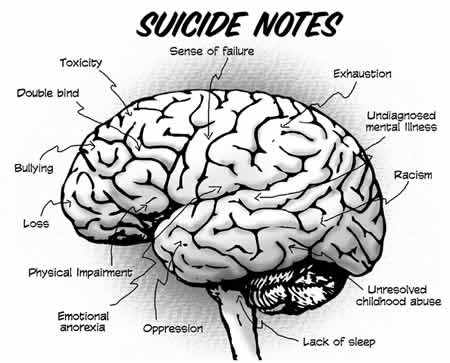
I've got a personal stake in this debate. A year and a half ago, I was diagnosed with cyclothymia, a "low-level" form of bipolar disorder. (I hesitate to use the term "low-level" because it's just as dangerous as full-scale bipolar--I just shift poles more quickly.) The suicide rate for unmedicated bipolar patients is one in three. My psychiatrist told me I was doing well not to have killed myself--and I complicated it.

The treatment I was given was Lamictal, an anti-seizure medication that somehow treats bipolar disorder--particularly that type of it that features depression more heavily than mania. Lamictal is not really comparable to SSRIs--it has few side effects. But there's something disturbing to me about the fact that I have a mental illness that psychiatrists cannot explain and that I take a medication that they also cannot explain. Like my students, I resent having to buy and take medication to get along in the world. My therapist told me to think of it like a diabetic who has to take insulin--the party line is that "chemical imbalance" stuff--but no one can tell me what chemical I naturally lack and need to have made up. I have by necessity an almost religious devotion to Lamictal, a blind faith in the pharmapsychology industry.

And yet I've been set free. I don't have depressive or manic episodes anymore, and I can function well in day-to-day life. My faith is rewarded, at least until that point in time when my body grows adjusted to Lamictal and I have to take another crapshoot to find another medication to make myself functional.

I'm afraid these are questions without easy answers; it's not as simple as my students want it to be (or as the pharmapsychology industry wants it to be, for that matter). I feel that in terms of psychiatry, we're still in the Dark Ages, applying leeches and mercury until we find something that we can explain. Doctors, as Hippocrates and Foucault suggest, are the new priesthood, and the rest of us are lighting tapers and dropping coins in the collection plate.