Showing posts with label Shakespeare. Show all posts

Friday, June 19, 2009

Friday Links

Wednesday, April 22, 2009

Bury Me


Hello, you few readers who are left. I know it's been a bad semester in terms of posting, but I'm now done with the bulk of my coursework and will (I hope) be posting more, especially now that I've begun reading in earnest for my comprehensive exams. Be ready for months of very tiresome posts on Existentialism.

In the meantime, here's the basic plot of the two papers I wrote this semester.

"'The Snake Was There Before Adam': Faulkner's Inversion of Augustinian Ponerology." I build off of my earlier post on Quentin Compson as a failed St. Augustine but recast it in much more theological terms. In brief, I argue that Faulkner's Sanctuary presents us with a ponerology that's the exact opposite of St. Augustine. Here, good is a privation of evil, and it is the male element that most clearly signifies nothingness. As femaleness is biologically a lack of maleness, so good is a lack of evil. This is a bleak worldview, especially since the mingling of female and male is necessary for the race's survival.

"More Art with Less Matter: Anxiety of Meaninglessness in 'Gertrude and Claudius.'" I examine Updike's much-neglected "prequel" to Hamlet and argue that, in its inversion of "good" and "bad" characters and its influx of religious and theological references--Claudius at one point or another represents just about every religion ever conceived--Updike turns Hamlet from a mere tragedy to something much, much darker: a negation of all meaning, be it interpersonal, religious, or philosophical.

I guess it's been a dark semester, you might say. More later.

Tuesday, March 31, 2009

Look Into My Heart, and You Will Sort of Understand

Shakespeare had good political reasons to set Macbeth in Scotland; he began writing the play in 1603, just as James VI of Scotland became James I of England. James was a Stuart, of course, and as Stephen Greenblatt helpfully explains in the footnotes to the Norton edition of Macbeth, Banquo, to whose descendants the weird sisters promise the throne, was mythologically the beginning of the Stuart line. So Macbeth, in a political reading, sounds a bit like the Aeneid, in that it exists to grant divine sanction to an earthly king.

But in the 17th century, Scotland was also the main hub of Presbyterianism in what would eventually be called Great Britain, and with that in mind, it’s hard not to pick up traces and hints of Calvinism in Macbeth, particularly in its intersection of divine providence, prayer, and human action and autonomy.

The events of the play are well-known—the weird sisters prophesy that Macbeth will be king of Scotland, and rather than wait for fate to make itself happen, Macbeth and his wife take matters into their own hands, slaughtering King Duncan and installing themselves in the castle. This works out well for awhile, until they are inevitably discovered and violently deposed.

It’s fundamentally a play about the depravity of man, a topic handled ad nauseam by Calvin in the Institutes:
Original sin, therefore, seems to be a hereditary depravity and corruption of our nature, diffused into all parts of the soul, which first makes us liable to God’s wrath, then also brings forth in us those works with Scripture calls “the works of the flesh” . . . Those who have said that original sin is “concupiscence” have used an appropriate word, if only it be added—something that most will by no means concede—that whatever is in man, from the understanding to will, from the soul even to the flesh, has been defiled and crammed with this concupiscence. (II.i.8)
Humanity must follow God’s law, and yet we are utterly powerless to do so thanks to total depravity. Thus, to do the right thing and thus to please God, we must petition God for his instruction and aid. Calvin’s great 20th-century heir, Karl Barth, goes into further detail on the topic in his little book appropriately titled Prayer:
What is to be said, what is to be done, when we are confronted with the fact that no one obeys the law perfectly, whereas the law exacts perfect obedience, and when we do not perfectly fulfill it, we do not fulfill it at all? However, we are believers, that is, people who have the beginnings of faith . . . God says to me, “Put your trust in me, believe in me.” And I go forward, I believe; but while going forward, I say, “Come to the help of my unbelief.”
All of this is, predictably enough, bound up in the doctrine of providence. Calvin suggests that while God is in control of every action, we are nevertheless responsible for the wickedness we enact. (Here is where Calvin’s theology becomes very difficult to follow, and here is where Calvin says that we have to accept this intersection as a mystery, something beyond our understanding.) Thus, while the future is always already decided, God will also change it if we petition him to guide us. (As I said, this is a really tough doctrine to get your head around.)

It’s this paradox that’s at the heart of Macbeth. The weird sisters—the play’s thematic replacement for God—predict and perhaps control the future, and when Macbeth and Banquo are hailed as the king and the father of future kings, respectively, they’re almost immediately thrown into a battle with the big black heart at the center of their souls. We see this as early as the top of Act I, Scene 7, where we find Macbeth arguing with himself over the correct action:
If it were done when ‘tis done, then ‘twere well
It were done quickly. If th’assassination
Could trammel up the consequence, and catch
With his surcease success: that but this blow
Might be the be-all and end-all, here,
But here upon the bank and shoal of time,
We’d jump the life to come. (I.vii.1-7)
His better angels may not want him to do the right thing for its own sake, but they at least recognize the threat of divine punishment inherent in wicked actions. (Calvin calls this a totally legitimate reason for seeking God in Institutes II.viii.4.) But his sin is a sin of omission long before it’s a sin of commission—never in the play does he seek God’s help or guidance, and further, instead of submitting to divine providence, he attempts to take control of it.

We see this clearly much later in the play, when he hires three murderers, a clear human perversion of the three witches who reveal his fate—and then again when he picks which parts of the sisters’ final prophecies to him to believe, choosing to believe that no man of woman born will be able to kill him but ignoring for all intents and purposes, their advice to fear Macduff.

Lady Macbeth, as the traditional readings say, is even worse, not because she urges Macbeth to kill Duncan (milk of human kindness aside, he was going to do that eventually anyway, since he’s incapable of doing the right thing without divine intervention and since he doesn’t bother to seek it), but because she has no inkling that there’s a right thing to do. She’s depraved to an extent that Macbeth is not because she no longer recognizes the law of God that’s written into the world. (She’s not alone, by the way—Calvin says that none of us is capable of correctly applying general revelation.) When the hound of heaven finally catches up with her in Act V, her depravity is more than she can bear, and instead of petitioning for forgiveness, she takes matters into her own hand in the most extreme way possible.

Banquo is our model of man’s proper attitude toward his depravity. He’s given a similar prophecy to Macbeth, one that suggests that he may be able to kill the new king and occupy the throne himself. And he, too, wrestles with the dark side of his own nature. The difference, however, is that he pleads for divine aid: “Merciful powers, / Restrain in me the curséd thoughts that nature / Gives way to in repose” (II.i.7-9). Thus, while he’s murdered, he’s murdered as a righteous man, one who has relied on God to overcome his depravity and one who will ostensibly be rewarded in the afterlife, not for his action, but for his lack of action.

It’s for this reason that I find Macbeth to be fundamentally different in theme and tone from Shakespeare’s other tragedies, such as Hamlet and King Lear. This play, best I can tell, is one of his few plays where the bad guys genuinely get it in the end with a relative minimum of innocent death. Where God was capricious in Lear and, perhaps, nonexistent in Hamlet, here he seems to have a real sense of justice, answering prayers and punishing those who are too proud to offer them.

Tuesday, March 3, 2009

In Which the Curtain Is Sewn Back Together


I read Titus Andronicus for the first time as a pretentious high schooler looking for universal verities, and I was horrified by what I found. The play is essentially a slasher film, a terrible bloodbath in which no one is redeemed and even the “good guys” are bad. (Or at least that’s what I thought.) Not that I was alone in this conviction. Titus is the red-headed stepchild of Shakespeare’s corpus, read far less than Hamlet or King Lear or even Measure for Measure and disdained by scholars from all traditions.

Now that I am a pretentious graduate student forced to read the play for a class, I’ve found a lot more to admire. There’s a certain kind of beauty in the action of the play, a certain fidelity in the midst of the horror. And—since it’s still what I mostly look for—there are universal verities, in this case a view of human nature that would make Calvin blush and a vision of the government that would make Ron Paul cheer.

At the outset of the play, we find a Rome in which Church and State have completely collapsed into one another. Everyone seems to believe himself a god. The Roman emperor was divinized, of course, and Saturninus promises Lavinia that he will “in the sacred Pantheon her espouse” (I.i.242). Meanwhile, Titus seems to expect the type of autonomy and respect generally accorded to the gods: “Nor thou nor he are any sons of mine. / My sons would never so dishonour me” (I.i.290-291). He gets to decide not only who lives and who dies but how people are related to one another, and this right seems to proceed from his position as a great general.

Furthermore, every State believes itself to be divine, as we can see right off that bat with Tamora’s speech just over 100 lines into the play:
But must my sons be slaughtered in the streets
For valiant doings in their country’s cause?
O, if to fight for king and commonweal
Were piety in thine, it is in these. (I.i.112-115)
So all countries are the same—or else we can’t really tell which ones are better, so we have to have mercy on all patriots, on all martyrs. All states become divine, and so the conflict between the Romans and the Goths—or, presumably, between the Romans and the Gauls and whoever else they conquer—are a divine contest, similar to the ones waged on Mt. Olympus.

As such, everyone in the play believes himself to be godlike, and a central question in Titus is, What is piety? In the beginning, we seem to have a conflict between mercy and justice. Tamora urges Titus to practice mercy: “Wilt thou draw near the nature of the gods? / Draw near them in being merciful” (I.i.117-118). But the Greco-Roman gods are traditionally not particularly merciful. Titus may be closer to what they’re actually like:
These are their brethren whom your Goths beheld
Alive and dead, and for their brethren slain
Religiously they ask a sacrifice.
To this your son is marked, and die he must
T’appease their groaning shadows that are gone. (I.i.122-126)
The gods require Agamemnon to sacrifice Iphigenia, then allow Clytemnestra to slaughter him when he gets home from the Trojan War. They want what they want and show no mercy on anyone, best I can tell. So Rome acts like the gods, indeed, sets itself up as a god. (Tamora and the Goths, of course, are exactly the same way—she begs for mercy for her sons but extends no mercy to anyone at any time. She’s among the most wicked of Shakespeare’s women, right up there with Lady Macbeth.)

In the next act, Tamora moves from being divinized by her forced marriage to Saturninus to divinizing herself, at least according to Aaron the Moor:
Now climbeth Tamora Olympus’ top,
Safe out of fortune’s shot, and sits aloft,
Secure of thunder’s crack or lightning flash,
Advanced above pale envy’s threat’ning reach. (II.i.1-4)
Even more interesting is that the genders have flipped, and now the man (Aaron) relies upon the woman (Tamora) to divinize him: “Then, Aaron, arm thy heart and fit thy thoughts / To mount aloft with thy imperial mistress” (II.i.12-13). She thus welcomes her lover into the State, makes him into a god even crueler than herself, even crueler than Titus, even crueler than Odysseus’ Poseidon. His name is significant here, as it brings to mind Moses’ brother Aaron, the first priest of the Israelites.

The end effect of all this divinization of and in the State is the brutal slaughter and humiliation of nearly everyone in the Andronicus family. Whatever one may say about Titus, however, he is not stupid, and he recognizes the true cause of all his misery. In the third act, he loses faith in the State, and Shakespeare uses language that resembles the loss of faith in the gods we find in, say, Euripides’ Heracles. He says that the Tribunes can’t hear him but wouldn’t listen if they could, and he memorably renounces Rome altogether:
Why, foolish Lucius, dost thou not perceive
That Rome is but a wilderness of tigers?
Tigers must prey, and Rome affords no prey
But me and mine. How happy art thou then
From these devourers to be banished! (III.i.52-56)
Here is a complete loss of faith in the State—Titus is not so much an atheist as a maltheist. And the comparison is apt because in this play, as in ancient Rome itself, we have a nearly complete conflation of the State and the Divine. But the State is made of human beings—Shakespeare even belabors the point that the people elect the Emperor—and so how can it be perfect?

Later, the genuine (at least in the world of the play) gods answer Marcus’ prayer at IV.i.65-66: “Apollo, Pallas, Jove, or Mercury / Inspire me, that I may this treason find.” He’s separated the Divine from the State, although he hedges his bets with the gods instead of praying to one. That’s just the nature of polytheism, however—the Andronici have learned genuine piety, which is always directed at the genuinely divine rather than the cardboard god of the State.

And so in the end, every figure that has previously been divinized the State—Titus, Tamora, Saturninus, and even Aaron—is dead, and Titus’ son Lucius is left to run Rome. But he seems to run the State in a totally different way; at no point does he declare himself divine, and so there seems to be a sea change in the makeup of the State; in short, he has separated Church from State. (This is not historically accurate, but that doesn’t much matter.)

Such issues must have weighed heavily on Shakespeare, who lived in an England that had changed from Catholic to Protestant, back to Catholic, and then back to Protestant again, slaughtering those on the other side. “Enough,” he seems to say here, and recommends that the State not concern itself with religious matters, in order to save both faith and government.

Sunday, April 13, 2008

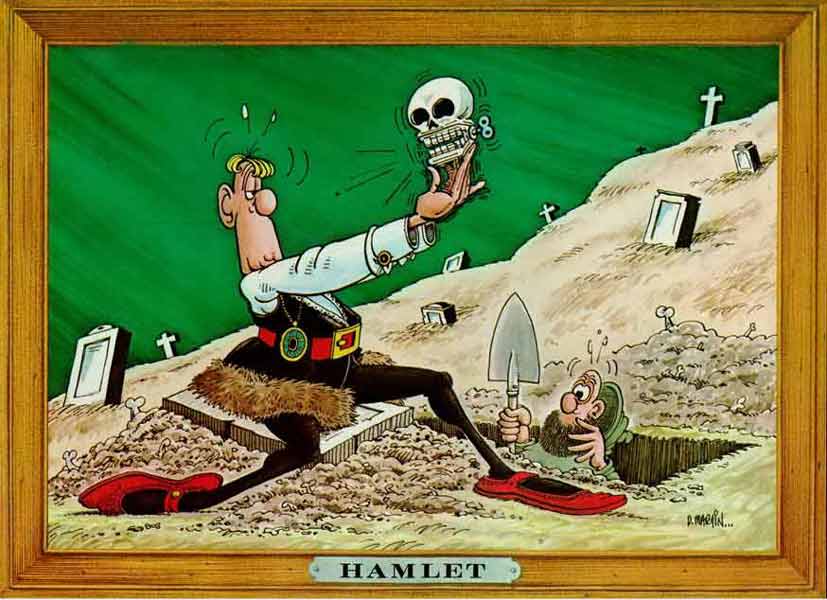
Upcoming Series: Summer of Hamlet


So because V. and I are both incredible nerds, we're devoting our summer to reading various versions and adaptations of Hamlet. And because we're both incredible nerds, we're taking you along for the ride, posting every yawn-inspiring moment of it to this blog. Here's our schedule, with dates left off because we're not yet to that level of incredible nerditude:

- William Shakespeare, Hamlet. Naturellement.
- Tom Stoppard, Rosencrantz and Guildenstern Are Dead. A crazy absurdist comedy based on Hamlet's indistinguishable buddies. We're reading this one early on because the Shakespeare Tavern in Atlanta is putting it on May 9 through June 1, and we want to be able to read the play first.
- John Updike, Gertrude and Claudius. This whole project began as a way of forcing Shakespeare scholar V. to read Updike. I've not read this novel myself, but it's apparently a prequel to the play that leaves Hamlet mostly out of things. It'll be interesting to see how ostensible sexist Updike treats that dirty whore Gertrude.
- Heiner Müller, Hamletmachine. V. suggested this one, which I've never heard of. Müller condenses the play into eight inpenetrable postmodernist pages.
- Film: Hamlet. The classic and influential Olivier performance. I'm not wild about this idea, but we figured we needed to have a straight performance of the play.
- Film: Hamlet 2000. Yes, the Ethan Hawke version. Why Ethan Hawke and not Mel Gibson or Kenneth Branaugh? Because Ethan Hawke doesn't hate Jews, and he never cheated on Emma Thompson.
- Film: The Lion King. I love this movie, and it was my first exposure to the play. I was twelve when I first saw it. V. was eight, and even then, she thought it was a hacky ripoff of Shakespeare.

The semester ends in a few weeks, and I hope we'll get right on this series. In the meantime, if you have any suggestions as to texts or films to add to the mix, we'd love to hear them.

Sunday, March 30, 2008

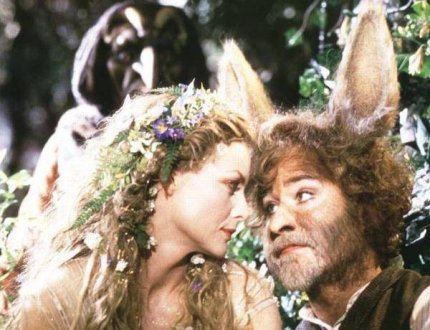
"A Midsummer Night's Dream"


So I decided to assign Shakespeare to my Freshman Comp II students, despite my never having read Shakespeare in a college course. Why should their education be deficient just because my own was?

I wouldn't have picked A Midsummer Night's Dream. I'd read it once before, seven years ago when I was working night shift at a seedy and yellowed motel in Lavonia, Georgia. I struggled through an unannotated edition of it at 1 and 2 in the morning for about a week, getting only some of the plot and none of the jokes, and then I rented the terrible Calista Flockhart version and watched it on the 13" television behind the counter.

But the UGA Theater Department is doing Midsummer in a few weeks, and I decided that the extra credit I could offer students for seeing a production of it outweighed my own incompetence when it came to the play. But I was nervous teaching it. I suspect that all teachers are occasionally afraid they will be exposed for the frauds they are convinced they are, and I figured it was finally my turn for unmasking.

It didn't help that about half of my class had read the play in high school. "Oh, Lord," I thought. "Their no doubt highly trained high-school teachers have picked this play apart for everything of value in it, and I'm going to be the last vulture to the party."

Never, however, underestimate the laziness of high-school English teachers. The students who had read the play before were familiar with the plot, but it didn't seem like anyone had ever encouraged them to look at the issues under the surface of the play: the conflict between reason and insanity, the undermining of love's free will, the class struggles, etc. And as for my paltry knowledge of Elizabethan customs, I learned quickly that the one-eyed man is king in the land of the blind, as the old cliche says.

Or maybe I'd just picked up enough about life in the 16th century from my Shakespeare-free British literature courses and from dating a Shakespeare scholar. On the first day of our class discussion, I managed to talk for half an hour about conventions of the day. It also helped that the play was set in ancient Greece. Due to the continual inferiority complex I mentioned in the last post, I constructed an enormous chronological list of "Great Books" a few years ago, and last summer I happened to read through all the Greek tragedy. So I was pretty much ready for questions about the location of the action of the play, and I knew enough to get through questions about the location of its writing.

More to the point, I suppose, I genuinely loved this play. It was much funnier than I'd remembered it being--uproariously funny, in fact, no doubt to the chagrin of my terrible 9th-grade English teacher, Mrs. Wise, who told us that Shakespeare's comedies weren't funny in the way we think of funny. Quite to the contrary: Midsummer is exactly the type of thing a fourteen-year-old boy would laugh at, provided he could get through the Early Modern English.

I had to explain some of the jokes to the class, of course. They've been conditioned their entire lives to see Shakespeare as the stuff of the upper-crust, and maybe their minds are just too innocent to figure out why the playwright named his characters "Flute," "Bottom," and "Puck." I had them read the funny scenes out loud in class, and I laughed exaggeratedly at the funny parts. I'm not sure if that helped them figure out what was funny or if it just made them think I'm a mental patient.

I found our brief drama unit rewarding, though, for the same reason that I found our poetry unit rewarding: Students came into the class thinking they hated Shakespeare and left with at least a tenuous respect for him. I suppose I can say the same about myself.