Showing posts with label British. Show all posts

Tuesday, March 31, 2009

Look Into My Heart, and You Will Sort of Understand

Shakespeare had good political reasons to set Macbeth in Scotland; he began writing the play in 1603, just as James VI of Scotland became James I of England. James was a Stuart, of course, and as Stephen Greenblatt helpfully explains in the footnotes to the Norton edition of Macbeth, Banquo, to whose descendants the weird sisters promise the throne, was mythologically the beginning of the Stuart line. So Macbeth, in a political reading, sounds a bit like the Aeneid, in that it exists to grant divine sanction to an earthly king.

But in the 17th century, Scotland was also the main hub of Presbyterianism in what would eventually be called Great Britain, and with that in mind, it’s hard not to pick up traces and hints of Calvinism in Macbeth, particularly in its intersection of divine providence, prayer, and human action and autonomy.

The events of the play are well-known—the weird sisters prophesy that Macbeth will be king of Scotland, and rather than wait for fate to make itself happen, Macbeth and his wife take matters into their own hands, slaughtering King Duncan and installing themselves in the castle. This works out well for awhile, until they are inevitably discovered and violently deposed.

It’s fundamentally a play about the depravity of man, a topic handled ad nauseam by Calvin in the Institutes:
Original sin, therefore, seems to be a hereditary depravity and corruption of our nature, diffused into all parts of the soul, which first makes us liable to God’s wrath, then also brings forth in us those works with Scripture calls “the works of the flesh” . . . Those who have said that original sin is “concupiscence” have used an appropriate word, if only it be added—something that most will by no means concede—that whatever is in man, from the understanding to will, from the soul even to the flesh, has been defiled and crammed with this concupiscence. (II.i.8)
Humanity must follow God’s law, and yet we are utterly powerless to do so thanks to total depravity. Thus, to do the right thing and thus to please God, we must petition God for his instruction and aid. Calvin’s great 20th-century heir, Karl Barth, goes into further detail on the topic in his little book appropriately titled Prayer:
What is to be said, what is to be done, when we are confronted with the fact that no one obeys the law perfectly, whereas the law exacts perfect obedience, and when we do not perfectly fulfill it, we do not fulfill it at all? However, we are believers, that is, people who have the beginnings of faith . . . God says to me, “Put your trust in me, believe in me.” And I go forward, I believe; but while going forward, I say, “Come to the help of my unbelief.”
All of this is, predictably enough, bound up in the doctrine of providence. Calvin suggests that while God is in control of every action, we are nevertheless responsible for the wickedness we enact. (Here is where Calvin’s theology becomes very difficult to follow, and here is where Calvin says that we have to accept this intersection as a mystery, something beyond our understanding.) Thus, while the future is always already decided, God will also change it if we petition him to guide us. (As I said, this is a really tough doctrine to get your head around.)

It’s this paradox that’s at the heart of Macbeth. The weird sisters—the play’s thematic replacement for God—predict and perhaps control the future, and when Macbeth and Banquo are hailed as the king and the father of future kings, respectively, they’re almost immediately thrown into a battle with the big black heart at the center of their souls. We see this as early as the top of Act I, Scene 7, where we find Macbeth arguing with himself over the correct action:
If it were done when ‘tis done, then ‘twere well
It were done quickly. If th’assassination
Could trammel up the consequence, and catch
With his surcease success: that but this blow
Might be the be-all and end-all, here,
But here upon the bank and shoal of time,
We’d jump the life to come. (I.vii.1-7)
His better angels may not want him to do the right thing for its own sake, but they at least recognize the threat of divine punishment inherent in wicked actions. (Calvin calls this a totally legitimate reason for seeking God in Institutes II.viii.4.) But his sin is a sin of omission long before it’s a sin of commission—never in the play does he seek God’s help or guidance, and further, instead of submitting to divine providence, he attempts to take control of it.

We see this clearly much later in the play, when he hires three murderers, a clear human perversion of the three witches who reveal his fate—and then again when he picks which parts of the sisters’ final prophecies to him to believe, choosing to believe that no man of woman born will be able to kill him but ignoring for all intents and purposes, their advice to fear Macduff.

Lady Macbeth, as the traditional readings say, is even worse, not because she urges Macbeth to kill Duncan (milk of human kindness aside, he was going to do that eventually anyway, since he’s incapable of doing the right thing without divine intervention and since he doesn’t bother to seek it), but because she has no inkling that there’s a right thing to do. She’s depraved to an extent that Macbeth is not because she no longer recognizes the law of God that’s written into the world. (She’s not alone, by the way—Calvin says that none of us is capable of correctly applying general revelation.) When the hound of heaven finally catches up with her in Act V, her depravity is more than she can bear, and instead of petitioning for forgiveness, she takes matters into her own hand in the most extreme way possible.

Banquo is our model of man’s proper attitude toward his depravity. He’s given a similar prophecy to Macbeth, one that suggests that he may be able to kill the new king and occupy the throne himself. And he, too, wrestles with the dark side of his own nature. The difference, however, is that he pleads for divine aid: “Merciful powers, / Restrain in me the curséd thoughts that nature / Gives way to in repose” (II.i.7-9). Thus, while he’s murdered, he’s murdered as a righteous man, one who has relied on God to overcome his depravity and one who will ostensibly be rewarded in the afterlife, not for his action, but for his lack of action.

It’s for this reason that I find Macbeth to be fundamentally different in theme and tone from Shakespeare’s other tragedies, such as Hamlet and King Lear. This play, best I can tell, is one of his few plays where the bad guys genuinely get it in the end with a relative minimum of innocent death. Where God was capricious in Lear and, perhaps, nonexistent in Hamlet, here he seems to have a real sense of justice, answering prayers and punishing those who are too proud to offer them.

Saturday, November 15, 2008

The Hoax That Ate Itself

When T.S. Eliot’s The Waste Land was first published in the October 1922 issue of The Criterion, it appeared without one of its most distinctive features: the author’s footnotes, which complicate and obfuscate--but only occasionally elucidate--the poem. Two months later, the poem was published in book form in the United States, this time with the footnotes attached. Eliot himself took a sly attitude toward the notes, saying famously in “The Frontiers of Criticism” that “I am, on one conspicuous occasion, not guiltless of having led critics into temptation”--a statement that suggests that the addendum to his most famous work is a type of scam or hoax.

Eliot's footnote scam was not without precedent. Edmund Spenser’s 1587 Shepheardes Calender features, amended to the main text, a series of introductions and footnotes by one “E.K.,” often considered to be a pseudonym for Spenser himself. E.K.’s gloss is inconsistent--sometimes it is insightful, sometimes ironic--but, as Theodore L. Steinberg points out, “the reader of the Calender can--and should--regard E.K.’s introductions and glosses as an integral part of the Calender, helping Spenser to develop his themes.”

As Steinberg points out, E.K. draws ironic attention toward Spenser’s ideas; when, for example, he disclaims the influence of John Skelton upon the name Colin Clout--an influence which Steinberg claims as “obvious"--the reader recognizes how far off the glosser must be and clings all the more strongly to Skeltonic influence. F.O. Matthiessen notes an additional motivation for the existence of E.K., Spenser’s “desire to have his poems rival the works of classical antiquity even to their appearance in a volume with annotations” by a third party, even if he had to invent that third party himself. The gloss on The Shepheardes Calender, therefore, ends up being ironic and fraudulent but still in the service of an important task.

Eliot was, of course, intimately acquainted with Spenser, as he appeared to be intimately acquainted with nearly every English poet. In his essay “What Is a Classic?” for example, he refers to “the genius of Spenser,” even if that genius seems to consist chiefly in preparing a way for John Milton. More to the point, Eliot quotes Spenser’s Prothalamion in line 176 of The Waste Land (“Sweet Thames, run softly, till I end my song”).

This awareness does not, of course, prove that Eliot was thinking specifically of the E.K. gloss when he was composing his notes for The Waste Land, but, in composing a semi-ironic commentary on his own text, The Shepheardes Calender must have at least crossed his mind. But that is not to say that he modeled his own footnotes on Spenser’s. Indeed, Matthiessen says that, since Eliot’s notes appear under his own name, they cannot be a cultivation of antiquity. Rather, Eliot’s notes “are simply a consequence of his desire to strip the form of his poem to its barest essentials in order to secure his concentrated effect.” In other words, the footnotes are an earnest attempt to nail down meaning, to direct readers to the sources for Eliot’s quotations and paraphrases.

Matthiessen’s explanation, however, ignores both Eliot’s wry sense of humor and the circumstances surrounding the creation of the notes. As Russell Elliott Murphy describes it, the monograph of The Waste Land would have had to include sixteen blank pages, due to the peculiarities of printing processes. So “Eliot was prevailed upon to provide some additional poetry to complete the volume. He opted, however, to provide the notes instead.” He thus--to some extent, anyway--included the notes under duress.

However, Jo Ellen Green Kaiser suggests that this story is at best only partially true (and perhaps a complete fiction), that in fact “Eliot had the notes in mind before he began serious negotiations with his eventual publisher . . . and that he had finished composing them several months before the poem first appeared in The Dial.” If Kaiser is correct, then the footnotes move from the earnest interpretation aid suggested by Matthiessen into a joke or hoax that “deflect[s] the cultural crisis represented in the poem onto the act of reading, suggesting that the disorder seemingly so evident in the poem is in fact the fault of the reader.” The notes, then, are meant to suggest a concrete meaning--or at least a structural order--that does not, strictly speaking, exist in the poem.

At any rate, the footnotes have to some extent benefited readers over the years, beginning with the Modernist critical powerhouse Edmund Wilson, who had access to the notes before their printing. Kaiser reports that “Before reading the notes . . . Wilson found the structurally fragmented poem representative of the ‘chaotic, irregular, fragmentary’ experiences that Eliot . . . had used to describe the ‘disassociated’ modern mind.”

But in a September 1922 letter to John Peale Bishop, Wilson says,
I am much excited about Eliot’s The Waste Land, which I have just read . . . it is certainly his masterpiece so far. He supplements it with a set of notes almost as long as the poem itself, explaining the literary, historic, anthropological, metaphysical, and religious significances to be found in it; but the poem, as it appears to me from two or three cursory readings, is nothing more or less than a most distressingly moving account of Eliot’s own agonized state of mind during the years which preceded his nervous breakdown.
The footnotes to the poem thus allow Edmund Wilson--and the thousands of readers who followed in his wake once the notes were published with the monograph--to transform something disturbing and chaotic into something understandable, something with structure and meaning. Further, the notes--contra, perhaps, to Matthiessen--make the poem something historical, as opposed to the modernist whirlwind, unconnected with history—that “dissociated” sensibility Wilson initially detected in the poem.

All of this sounds very fine and good, as though the notes do exactly what Eliot intended for them to--that is, they make sense of a poem that is at times nonsensical. But Eliot himself disdained and dismissed the notes in his “The Frontiers of Criticism,” calling them a “remarkable exposition of bogus scholarship.” Eliot is penitent in this essay. “My notes stimulated the wrong kind of interest among the seekers of sources,” he says. “I regret having sent so many enquirers off on a wild goose chase after Tarot cards and the Holy Grail.”

Eliot’s disavowal and repudiation of the notes thus makes any definitive remark on them difficult if not impossible, particularly since he propagates the old story that they were included because the poem was too short, which Kaiser disproves. But we can, perhaps, suggest that the notes were intended more or less as a hoax, but that they were received earnestly. And even after Eliot’s disavowal of them--even after the hoax was revealed as a hoax--the vast majority of readers (Kaiser and a few others excepted) continued to read them as an earnest and helpful addition to the poem. Eliot’s hoax on his readers, by the end of his lifetime, had been turned around and warped until it was a hoax on the poet himself, who is now destined to be (in his opinion) misread, his readers conducting “bogus scholarship” based on “the wrong kind of interest.” In the end, the footnotes to The Waste Land may be at their best a cautionary tale to authors who wish to pull a fast one on their readers.

Monday, July 28, 2008

Judge Vilhelm Replies


I've been reading noted literary critic James Wood's first and only novel, The Book Against God and am enjoying it as much as I enjoy his criticism in The New Yorker. It's the story of Thomas Bunting, who's a seventh-year PhD student in philosophy who can't finish his dissertation because of a much more pressing and elaborate project, the Book Against God, which is pretty much exactly what it sounds like.

I'm not too far into the novel just yet, but I suspect what we've got here is a portrait of the Kierkegaardian religious sphere removed from believe in God. (I doubt Wood, who I think is an atheist, intended such a meaning, but thank the Lord or evolution for the Death of the Author.) Thomas Bunting is, in my early analysis, a sociopath, a man who lies compulsively and feels no remorse, who can't find a philosophical difference "between lying to one's wife and lying to a corporation." This statement horrified me at first, but upon further analysis, it's akin to what I was taught growing up in a Southern Baptist church: No hierarchy of sins exists, and theologically if not practically, they are all the same. (I am interested to know if other brands of Christianity teach such an idea.) At any rate, Thomas ends up as a moral absolutist of sorts, even though he rejects morality.

So it makes sense that he describes Nietzsche as "one of my favorite philosophers," since his views echo the German's, specificially the essay "On Truth and Lying in a Non-Moral Sense." Nietzsche, a consummate atheist, argues that since consciousness "has no further mission that might extend beyond the bounds of human life," truth is
A mobile army of metaphors, metonymies, anthropomorphisms, in short a sum of human relations which have been subjective to poetic and rhetorical intensification, translation, and decoration, and which, after they have been in use for a long time, strike people as firmly established, canonical, and binding; truths are illusions of which we have forgotten that they are illusions.
Morality is therefore irrelevant to Nietzsche, and the prohibition against lying is a social construction and has no intrinsic value.

(I've often said that Nietzsche is the atheist I respect the most because he is the one who is unafraid to face directly the logical conclusion of materialism, that is, that there is no such thing as right and wrong or as value. We have no reason to do "the right thing," and further, we have no grounds on which to condemn anyone for doing something we find horrifying.)

Wood's book has value not just on its own terms, then, but because of what it suggests about Nietzsche, i.e., that he exists in the religious sphere without belief in God. But first: What on earth do I mean by the religious sphere? I wrote my thesis using this schema, so please bear with me as I ramble on . . .

Kierkegaard posits three spheres of existence, each of which telescopes and contains the one that precedes it. He does so chiefly in three books: Either/Or, Fear and Trembling, and Stages on Life's Way. The first sphere, the sphere in which most of us exist, is the aesthetic. The aesthete defines himself entirely by himself. He lives in his own head and has little genuine connection to the outside world. His relationships are thus necessarily strained, and indeed, the aesthetic resembles what Heidegger would later call the being-against-one-another (exactly what it sounds like). The aesthete believes himself to be happy but is deeply alienated--his sole goal in life is pleasure and more specifically, to avoid boredom, which after all is "the root of all evil."

A person enters the ethical sphere when he commits to a particular idea or theory, when he attaches himself to something outside of himself. Kierkegaard's example is of marriage, but the ethical could be any belief system--most religious folks are in the ethical sphere rather than the religious. (We shall see why in just a moment.) Walker Percy says that the great ethicists of our age are the artist and the scientist, and he suggests that both of them are in quiet despair, especially the artist. Reason and logic also belong to the ethical sphere.

The religious sphere is entered only when a person lays aside the ethical sphere in what Kierkegaard calls a "teleological suspension of the ethical" (later theologians would call it the "leap of faith," a term which Mr. K never uses). Kierkegaard's famous example is Abraham, who turned his back on the laws of society when God told him to sacrifice his son. One lays aside the ethical not to serve oneself but to serve God, and it's very important that this is not a teleological abandoning of the ethical but merely a suspension--Abraham is a knight of faith not because he was willing to sacrifice his son but because he knew that God would restore him. The religious sphere is a realm of pure subjectivity, and a person is enthralled only to God. Not very many people make it, and Kierkegaard says nothing, as far as I know, about what a person stuck in the religious with no belief in God would look like.

But I think Wood gives us just that, and here's why: Thomas Bunting's wife dislikes people "for only two reasons: it's either something murkily musical, or something elusively ethical." But he is unable to understand her system of demerits and demotion, and this failure to understand suggests a failure to understand both the aesthetic and the ethical. (The reasons for the ethical should be obvious, but Kierkegaard suggests that music belongs to the aesthetic sphere.) With those two spheres eliminated, Thomas has only one place to live, the religious, and given his affinity for Nietzschean thought, I don't think it's unreasonable to suggest that Nietzsche, too, exists in this sphere.

This connection explains the similarities between Kierkegaard and Nietzsche--I have often said that their ideas are basically the same, although they start from opposite places. They may meet here in the religious sphere, even if Nietzsche is unaware of it.

Tuesday, June 17, 2008

My Fist-Fight with Karl Barth


I generally follow Karl Barth on theological matters, but as I reread Helmet Gollwitzer's selections from Church Dogmatics, I find myself arguing with him on the subject of general revelation (which he calls "natural theology"). I'm not sure I'm exactly breaking from him yet--but I'm struggling.

Not only does Barth disbelieve in general revelation (as distinguished from the specific revelation of God we get through the life of Christ as attested to in the Bible), he views it as just another "Tower of Babel," a work by which man futilely attempts to commune with God:
Natural theology is the doctrine of a union of man with God existing outside God's revelation in Jesus Christ. It works out the knowledge of God that is possible and real on the basis of this independent union with God . . . But this means that in actual fact God becomes unknowable to him and he makes himself equal to God. (Church Dogmatics II.1)
All this fits in, of course, with Calvin's doctrine of total depravity--really extended in Barth's case to absolute depravity. If man is absolutely fallen, he cannot in the final analysis trust in his logic, his emotion, or his will. The only thing worth trusting is God's revelation, that is, the Word of God, that is, Jesus Christ.

But I've grown a little dissatisfied with Barth on this issue. Maybe that's a product of my reading Plato and admiring certain parts of him, or maybe its my attraction to the broader vision of mythology offered by Chesterton, Lewis, and Milton, but I am no longer content with Barth's pessimism toward anthropology, and I think this dissatisfaction stems from the sticky wicket of total depravity.

The doctrine is sometimes confused with absolute depravity (which again, I think Barth holds to)--in other words, all men are depraved, but each man is not completely depraved. But there's a different, as this passage from the Canons of Dordt, that famous argument against Arminianism, suggests:
The result of the fall is total depravity or corruption. By this is meant that every part of man is rendered corrupt . . . There was no part of his nature that was not affected by sin. (III, IV, Article 4)
The Canons make it clear, mind you, that this definition does not mean that man is entirely helpless; he still has "glimmers of truth." So the magnanimous view of world religions offered by Chesterton and Lewis is pretty much compatible with traditional Calvinism. But Barth extends Calvin's principle. In The Word of God and the Word of Man, he says that these glimmers of truth make man try to reach God; that is, they give him an inborn religious impulse like the one St. Augustine describes in the first paragraph of the Confessions. However, Barth cautions that this religious impulse is inextricably twinned by humanity's complete inability to follow it properly, to learn truths about God's nature. (This pair of doctrines, incidentally, was the "unsupportable" argument of the massive and excised John Updike chapter of my thesis.) Thus, mankind is impotent to save itself, and all its attempts to do so are bound to fail; only God's Word, Christ, revealed through the Bible, has the power to save or to reveal. Barth out-Calvins Calvin, or at least takes him to his logical conclusion.

Using my first post on Milton's "On the Morning of Christ's Nativity" as a representative of the more charitable view that other religions prefigure Christianity, let's see if Barth is really saying something so different. He says that man has a religious impulse So far, so good. All societies have their theologies, even if those theologies are secular, like the National Socialism of 1930s Germany or the god-free ethics of most of modern-day Europe. In Milton's poem, the Greek pantheon exists to prefigure Christ's birth, but they mysteriously fall silent and die away once the Word actually becomes Flesh. That sounds like an expression of Barth's second principle, that religious impulses lead only to failure. The religious structure created by the Greeks falls to pieces in the face of God's true revelation, just as Barth says all Towers of Babel are doomed to do.

And yet I do not think Barth is really saying the same thing as Milton (and Lewis, and Chesterton)--I think the idea that the Greek pantheon got even part of the essence of God right would stick in his craw. After all, for Barth, manmade religious structures are not putts that are a few inches off; they swing straight into the water hazard. The magnanimous system depends on general revelation; Barth denies any revelation other than Christ. I wonder if Frederick Buechner, that student of both Barth and Lewis, finds some way to bridge that gap. I need to comb through his catalogue.

It's Karl Barth week here at Ladder on Wheels. Later this week, I'll post about exactly why Barth so distrusts general revelation and why he may well be right; then I'll defend him against the common Evangelical critique that he hates the Bible.

Sunday, April 6, 2008

Roger Kimball Wises Up

Maybe Kimball read my last post. Arts and Letters Daily included a link this weekend to this article where he argues against Rudyard Kipling's racism (along with a typical Aesthetic argument).

I've not read Kipling (I've seen Disney's Jungle Book, which has its own share of odd racial tensions), so I can't join in on the discussion. Anyone?

Saturday, April 5, 2008

Eliot and the Five Types of Criticism


Here's the speech I gave my Comp II students at the top of this semester. I'm not sure if these ideas are totally viable or not--I worked them out on my own.

There are essentially five reasons that people call a particular work of art "great," the end result of which is that there are essentially five types of critics.

1) Aesthetic. "This is beautiful." In this category I class the 1890s Aesthetes (Wilde, Pater, et al), the New Critics (Wimsatt, Beardsley, Ransom), and what I term the Neo-Aesthetes (the Blooms, Frederick Crews, and Roger Kimball). In these latter, you tend to get a neo-Arnoldian streak of "preserving the best that Western civilization has to offer." I still call this Aesthetic.
2) Impressionist. "This moves me." I think this is the reason that most people start their love of literature. I am not aware of a major critic who primarily utilizes this method, however.
3) Moral. "This speaks the truth." I include in this category both the Christian critics and the Marxist critics, as well as the Black Arts folks from the 1970s. Moral critics tend to see art primarily as propaganda, as a political/social/religious vehicle for the Truth.
4) Social. Either "This changed things" or "This perfectly represents a given viewpoint."It is by means of social criticism that something like The Jungle--otherwise a poorly written book--ends up canonized or semi-canonized. Note that social criticism almost always has an element of moral criticism to it. There can be little argument that The Clansman perfectly represents a given viewpoint, but I do not think Paul Lauter is interested in putting it on one of his many canons.
5) Hermeneutic. "This is open for endless discussion." I used to call this the "deconstructive" school until Don Williams suggested that that particular term is too narrow and too polarizing. These critics value a work of art for its depth and the number of its possible interpretations.

If anyone would like to add a school of criticism to my schema, if anyone has found one that I've left off, please let me know.

Most people do not fit squarely into one of these categories, but I suspect close to all readers have one that lords over the other ones. I, for example, am primarily hermeneutic (and secondarily impressionist), and I have little to no interest in social criticism. My theory about these schools is that they're all more or less valid, but if you're in an argument over a particular work (like those tiresome canon arguments in the 1990s), there's no sense in arguing a different school than your opponent.

Let's say, for example, that Roger Kimball and Paul Lauter are arguing over whether we should take Othello out of the canon. (I have no idea if Lauter wants to or not.) Kimball will say, "This is a perfectly constructed play." Lauter will say, "This play is racist, and besides, we should take it out to open up the canon for other viewpoints." That argument is never going anywhere. Either Kimball needs to argue against the play's racism, or else Lauter needs to argue that the play is a piece of garbage on an aesthetic level.

I bring all this up because I am reading T.S. Eliot's selected prose right now, and he seems to subscribe to all of the schools. Eliot is pretty much forgotten as a critic, which I'm sure is a consequence of his being so closely associated with the New Critics. The New Critics loved Eliot because his poems were ideal for the New Criticism--they were tightly constructed and could (supposedly) be viewed on their own, without recourse to the author's intentions. I've taken three Literary Criticism and Theory classes, and I've never been taught Eliot's work, aside from a few offhand references to his "objective correlative."

That objective correlative is a particularly ugly aspect of the Aesthetic School; it's the idea that an author can toss together a given sequence of events or words and demand a particular emotional reaction from his readers. It sounds cynical to me, and a little too close to the sentimental fiction of the 19th century, in which the author would attempt via rhetorical tricks and bizarre plot points to make the reader cry on every page. It simultaneously utilizes and minimalizes the Impressionist School as a means to an Aesthetic end.

But something funny happened. When Eliot converted to Anglicanism in 1928, both his poetry and his criticism changed dramatically. I'll post about the differences between his pre- and post-Anglican poetry some other time, but his criticism opened up to all sorts of other directions, ones that the New Critics who praise Eliot seem to disregard.

For example, he begins to value the Impressionist over the Aesthetic. Emotions become the big deal for Eliot--he says in "The Music of Poetry" that "If we are moved by a poem, it has meant something, perhaps something important, to us; if we are not moved, then it is, as poetry, meaningless." Emotion is not the sole judge of good poetry, but it's a major judge, and the post-1930 Eliot seems to think it is in many ways a better judge than pure Aesthetic criticism.
In an essay on Henry James, he even criticizes dry intellectual approaches to criticism:
Englishmen, with their uncritical admiration (in the present age for France, like to refer to France as the Home of Ideas . . . In England ideas run wild and pasture on the emotions; instead of thinking with our feelings (a very different thing) we corrupt our feelings with ideas; we produce the political, the emotional idea, evading sensation and thought.
It seems clear to me that it was Eliot's conversion that moved him from "corrupting his feelings" to "thinking with them"; Aesthetic intellectualism led him to the depths of despair in "The Waste-Land," despair that he was just beginning to escape in "The Hollow Men" and "Ash-Wednesday," but it's in his criticism that he really seems rescued, able to feel again.

Christianity also led to his establishment as a Moral critic supreme; at the top of "Religion and Literature," he claims that "Literary criticism should be completed by criticism from a definite ethical and theological standpoint." He makes his own viewpoint clear, but his readers are not exactly instructed to follow it--the important thing in this essay is to have a standpoint. He no longer believes in objectivity, clearly. He also takes another delightful shot at the Aesthetes, one that reminds me of Walker Percy's The Second Coming, in which one of Will Barrett's aggravating friends reads Dante for the meter:
The people who enjoy these writings [The Bible, Jeremy Taylor, Clarendon, and Gibbon, among others] solely because of their literary merit are essentially parasites; and we know that parasites, when they are become too numerous, are pests.
Eliot is, of course, taking aim at his past self in quotes like these; his post-1930 criticism comes off like it's the ascending spiral staircase in "Ash-Wednesday," a method of purging oneself for divine purity. If he can decimate his former views enough, he's saved.

Elsewhere, he sounds like a Social critic. His criteria for a text being a "classic" involve, among Aesthetic considerations, its representing a particular culture. Indeed, it is the culture moreso than the text that is classical. Groups of authors pool their resources and influences to produce the cultural aura of the classical, and it's out of this that an individual author creates a classic text: "What we find, in a period of classic prose, is not a mere common convention of writing, like the common style of newspaper leader writes, but a community of text." Culture is extremely important for the post-'30 Eliot; his last two books attempt to provide a definition of culture and then figure out how to create one based on Christianity.

Finally, the seeds of postmodern criticism are latent in Eliot. In addition to his privileging of the reader's emotions and interpretations over the author's ("The meaning of a poem may be something larger than its author's conscious purpose, and something remote from its origins"), he levels the playing field between High and Low Art based on the number and importance of interpretations:
I incline to come to the alarming conclusion that it is just the literature that we read for "amusement," or "purely for pleasure" that may have the greatest and least suspected influence upon us. It is the literature which we read with the least effort that can have the most insidious influence upon us. Hence it is that the influence of popular novelists, and of popular plays of contemporary life, requires to be scrutinized most closely.
Now, Eliot is of course horrified by popular fiction; even after his conversion, he's always a snob. But if not exactly a hermeneutic critic himself, he throws the doors wide open for it: All texts, he seems to say, need to be examined and parsed out, especially the ones we don't want to.

My conclusion from all this is that it's time for a re-evaluation of Eliot's nonfiction writing by critics of all stripes. I suspect that everyone is going to find something in his essays to love--and many other things to hate.

Sunday, March 30, 2008

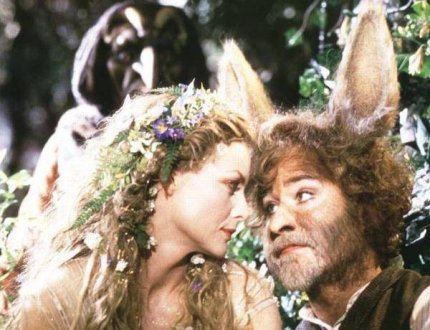
"A Midsummer Night's Dream"


So I decided to assign Shakespeare to my Freshman Comp II students, despite my never having read Shakespeare in a college course. Why should their education be deficient just because my own was?

I wouldn't have picked A Midsummer Night's Dream. I'd read it once before, seven years ago when I was working night shift at a seedy and yellowed motel in Lavonia, Georgia. I struggled through an unannotated edition of it at 1 and 2 in the morning for about a week, getting only some of the plot and none of the jokes, and then I rented the terrible Calista Flockhart version and watched it on the 13" television behind the counter.

But the UGA Theater Department is doing Midsummer in a few weeks, and I decided that the extra credit I could offer students for seeing a production of it outweighed my own incompetence when it came to the play. But I was nervous teaching it. I suspect that all teachers are occasionally afraid they will be exposed for the frauds they are convinced they are, and I figured it was finally my turn for unmasking.

It didn't help that about half of my class had read the play in high school. "Oh, Lord," I thought. "Their no doubt highly trained high-school teachers have picked this play apart for everything of value in it, and I'm going to be the last vulture to the party."

Never, however, underestimate the laziness of high-school English teachers. The students who had read the play before were familiar with the plot, but it didn't seem like anyone had ever encouraged them to look at the issues under the surface of the play: the conflict between reason and insanity, the undermining of love's free will, the class struggles, etc. And as for my paltry knowledge of Elizabethan customs, I learned quickly that the one-eyed man is king in the land of the blind, as the old cliche says.

Or maybe I'd just picked up enough about life in the 16th century from my Shakespeare-free British literature courses and from dating a Shakespeare scholar. On the first day of our class discussion, I managed to talk for half an hour about conventions of the day. It also helped that the play was set in ancient Greece. Due to the continual inferiority complex I mentioned in the last post, I constructed an enormous chronological list of "Great Books" a few years ago, and last summer I happened to read through all the Greek tragedy. So I was pretty much ready for questions about the location of the action of the play, and I knew enough to get through questions about the location of its writing.

More to the point, I suppose, I genuinely loved this play. It was much funnier than I'd remembered it being--uproariously funny, in fact, no doubt to the chagrin of my terrible 9th-grade English teacher, Mrs. Wise, who told us that Shakespeare's comedies weren't funny in the way we think of funny. Quite to the contrary: Midsummer is exactly the type of thing a fourteen-year-old boy would laugh at, provided he could get through the Early Modern English.

I had to explain some of the jokes to the class, of course. They've been conditioned their entire lives to see Shakespeare as the stuff of the upper-crust, and maybe their minds are just too innocent to figure out why the playwright named his characters "Flute," "Bottom," and "Puck." I had them read the funny scenes out loud in class, and I laughed exaggeratedly at the funny parts. I'm not sure if that helped them figure out what was funny or if it just made them think I'm a mental patient.

I found our brief drama unit rewarding, though, for the same reason that I found our poetry unit rewarding: Students came into the class thinking they hated Shakespeare and left with at least a tenuous respect for him. I suppose I can say the same about myself.