Showing posts with label Updike. Show all posts

Saturday, October 17, 2009

Book Review: 'My Father's Tears and Other Stories'

The party line on John Updike is that, while his novels are pretty good, it’s his short stories that will be his true legacy. I’ve always resisted this notion, not because there’s anything wrong with Updike’s short fiction but because his novels are so good. It’s in the longer fiction that we see the extent to which, contrary to some critics, Updike had something to say—given 300 pages to stretch it out, he moves beyond his famous descriptive skills and endows characters like Rabbit Angstrom or Roger Lambert with real philosophical import. The stories, on the other hand, are over in a flash, and more than any idea, you remember the turns of phrase and the images their author packs in.

The problem is that Updike didn’t release a good novel in the last thirteen years of his life. His last winner was 1996’s In the Beauty of the Lilies, which took everything he was good at and expanded it throughout four generations of would-be saints. It somehow hits all the things you associate with Updike—sex, death, popular culture, and religion—and puts them in an unfamiliar context, far from the dulleries of suburban wife-swapping that plagued late-period novels like Villages.

I’d mostly written Updike’s final decade off, in fact, after spending the first few months of 2009 reading Gertrude and Claudius, an interesting but not particularly successful “prequel” to Hamlet, and Terrorist, which tried its best to present a sympathetic portrayal of an Islamic radical but came out weak and flaccid. (It’s not quite as bad as everyone says it is, but it’s at best a noble failure.)

So reading My Father’s Tears and Other Stories, Updike’s final book, was a revelation. (I should say that it’s his final book as far as we know—one might imagine a Prince-esque vault full of unpublished fiction and poetry in Updike’s recently sold Beverly Farms estate, but given that the man published at the rate of 1.3 books per year, I find that prospect, however titillating, unlikely.) Updike had not lost his powers; he’d only lost the ability to express them in spurts of 300 pages. Indeed, the eighteen stories in this volume rank among his most effective work, bolstered by a new sort of melancholy one does not find in the best of his novels.

It’s impossible to read My Father’s Tears and Other Stories without thinking of Updike’s death, which followed the last story in the volume (“The Full Glass”) by eight months and which preceded the publication of the collection by five. With a few exceptions (“Morocco,” first published in 1979 and dealing with events a decade earlier, being the most obvious), Updike creates shadow-selves in these stories only to watch them decay or destroy them outright. There’s thus an air of suicide here, coupled with an obvious grasp at immortality, since Updike knows people will be reading his fiction long after his body has decayed.

The selves he presents us with are familiar—most of them could easily be Rabbit Angstrom or Piet Hanema or Roger Lambert, or for that matter, the Updike we discover beneath the fiction in his memoirs, Self-Consciousness. But, presented as they are in the winter of their lives, they are simultaneously unfamiliar. They’re aware of what awaits them in months of years, aware that the life they have drank so eagerly from for decades is about to slip through their fingers.

Their reactions vary; some, like our old friend David Kern, who shows up in two stories, do everything they can to recapture the past and make it part of whatever small future they have remaining for them. In “The Walk with Elizanne,” Kern meets his first girlfriend at his high-school class’s fiftieth reunion, discovers the secret meaning of life in male-female relationships:
Elizanne, he wanted to ask her, what does it mean, this enormity of our having been children and now being old, living next door to death? He had been the age then that his grandsons were now. As he had lived, he had come to see that for a man there is no antidote to death but a woman. Yet from where, he wanted now to ask Elizanne, does a woman draw this antidote, her cosmic balm? And does it work for her as well?
The story ends with a lovely description of the titular walk, one that redeems David’s sadness at the ravages of age and makes a sacrament of their innocence and exploration. David’s spiritual brother is the unnamed narrator of “The Full Glass,” who spends the story reminiscing on his attempts—successful and otherwise—to grasp life by the horns, to truly live it, to drink from a full glass.

Other characters can’t muster this effort. Martin Fairchild, the protagonist of “The Accelerating Expansion of the Universe,” finds himself faced with a cruel and uncaring universe, devoid, the scientists tell him, of a benign or benevolent divine presence. He can transcend it only through the violence that is done to him, as when he is injured by a purse-snatcher in Seville.

But this strangely pleasing incident only goes so far, and Martin finds himself alone when he returns home. He retreats to his barn, the home of an ancient cupboard owned by his mother before her death, a home for “Souvenirs of a life of which Fairchild was the last caring witness” (151). The story’s Flannery O’Connor-esque ending allows him a final moment of transcendence of his memory and of the universe’s blind watchmaker.

Some of Updike’s protagonists finally learn morality in their final years. Updike has always been a frustrating novelist for his steadfast refusal to judge any character or to present any clear moral; combined with his own antinomian sexual history and his continued profession of belief in Christianity, he and his autobiographical characters have always been an enigma. But in several of these stories—“Free” and “Outage”—they finally learn to love their wives and submit to a conventional sexual morality. I can’t say much more without giving away the ending of the story, a move that violates Updike’s own rules for reviewing books—but it’s nice to see their author taking a stand for once.

The true gem of My Father’s Tears and Other Stories, however, is “The Varieties of Religious Experience,” written shortly after the events of September 11, 2001. Updike takes the point-of-view of four participants in the terrorist attacks—an Episcopalian who, like Updike, watched the towers crumble from Brooklyn Heights; Mohamed Atta, who hijacked Flight 11 and spends his section of the story in a strip club, drinking whiskey and trying to fit in; an elderly woman who witnesses the heroism of those aboard Flight 93, who prays for mercy seconds before hitting the ground outside of Shanksville, Pennsylvania; and a bond trader on the top floor of the North Tower, who has his final conversation with his wife before jumping out the window.

Writing about such a horrific event, especially so soon after it happened, must be one of the very hardest thing an author can do, and numerous others—Don DeLillo comes to mind—have failed to produce compelling work out of the wreckage of the towers. But Updike succeeds largely because he refuses to draw conclusions; he presents these four stories without sentimentality and therefore succeeds in moving the reader. His use of religion is understated but effective; the Hand of God doesn’t appear in the wreckage, and the characters who maintain their faith in the face of tragedy do so for reasons even they don’t understand, which strikes me, at any rate, as accurate.

Aside from a few stories about his childhood—these have never particularly interested me—and a few that go nowhere (“Spanish Prelude to a Second Marriage,” for example, is overwhelmingly boring and detracts from the overall mood of the collection), My Father’s Tears and Other Stories is a moving end to the career of the person who may be the quintessential fiction writer of 20th-century America. Anyone disappointed by Seek My Face or The Widows of Eastwick would be wise to turn here before writing off Updike’s final decade.

Thursday, September 24, 2009

Esther's Version

Last time I wrote on John Updike’s Roger’s Version (please note the warning at the top of that page), I went somewhat outside the field of my own expertise and talked about the homosocial undercurrent that runs all through the novel. I returned to the book again this week while studying for my comprehensive exams, and this time through I focused much more on the theological parts of the novel than the sexual parts.

All for the best. I love Updike, probably more than I love any other author, but I hate his sex scenes—truly, viscerally hate them. They’re almost always unnecessary (though my last post gets to some of the reasons they might be present in Roger’s Version), and as the author aged, they just made him seem like a dirty old man. It was not for nothing that he won the Lifetime Achievement Bad Sex award.

So let’s ignore the sex scenes and focus on the theological debate. Roger’s Version presents us essentially with two versions of Christianity. In one corner, we have Roger, a professor of divinity who loves Karl Barth even more than he loves fantasizing about his wife sleeping with other men but who has completely lost his faith, at least as far as the reader can tell. And in the other corner, we have Dale Kohler, a graduate student in computer science who sets out to prove God’s existence via computer.

We are set up to trust Roger and to distrust Dale—after all, this is Roger’s version; he narrates the novel, and the only time we’re privy to Dale’s thoughts is when Roger imagines them. We know that Updike followed Barth on theological matters, and so when Roger quotes The Word of God and the Word of Man and says things like this—

If [God] is omnipotent, I would think it within His powers to keep hiding. And I’m not sure it isn’t a bit heretical of you to toss the fact of God in with a lot of other facts. Even Aquinas, I think, didn’t postulate a God Who could be hauled kicking and screaming out from some laboratory closet, over behind the blackboard—

we are inclined to believe him. Dale, meanwhile, is annoying in his fundamentalism and his tunnel-visioned zeal; however much he knows about science, we are inclined to believe him an arrogant fool.

But as you get to know him more, you start to realize how perceptive he is in his analysis of Roger, who uses God’s unknowability as an excuse to do anything he wants to do, including (spoiler alert) sleeping with his niece late in the novel. (His moral sense, like that of so many Updike protagonists, is nonexistent; he refers to his incest/adultery as “a small secret to protect.”) So Dale is exactly right when he tells Roger that

You don’t want God to break through. People in general don’t want that. They just want to grub along being human, and dirty, and sly, and amusing, and having their weekends with Michelob, and God to stay put in the churches if they ever decide to drop by, and maybe pull them out in the end, down that tunnel of light all these [near death experiences] talk about.

What we have in Roger’s Version, then, are two competing versions of nonbelief. Roger recognizes that the whole Christian enterprise is built on faith, but while he memorizes everything about Christendom, he doesn’t seem to have much faith at all. Dale, on the other hand, belies his own claims at faith when he attempts to remove the need for faith, proving God like a mathematical theorem. Both of these are unsatisfactory.

The odd twist in the novel is that Dale himself becomes an object of faith about midway through. Roger’s wife, Esther, cues us into the move when she says that “Dale sounds like a rather touching young man,” a declaration which Roger is quick to inform us comes “on no evidence.” That Roger imagines Esther sleeping with Dale does give us a limited explanation for the inclusion of the sex scenes (though it doesn’t explain why they have to be so disgusting): These fantasies are neither psychosis nor prophecy; they are something concrete for Roger to put his faith in.

As my Salinger post hints, however, faith qua faith is not the issue; it must be properly directed to be helpful or meaningful in any real way. Thus, any religious leanings Roger’s fantasies about Dale and Esther reveal are tainted with the stench of Karl Barth’s Towers of Babel, false paths to a false God. These fantasies thus reveal Roger’s lack of faith in the Christian God even more clearly. All he has to trust in is sex, and not even his own sex: sex he may be completely fabricating between his wife and his worst enemy.

Again, the novel’s ending appears to confirm Roger’s theology at the expense of Dale’s. At a cocktail party, Dale talks with Myron Kriegman, a snide and fast-talking atheist who causes the young man to lose his faith nearly completely. Roger’s brand of fideism has seemingly been proven right—his faith, however mediocre and lukewarm, is safe from the proofs of materialism and the meanness of the world. It’s an ugly picture of faith for many evangelicals. Given the choice of being lukewarm and secure like Roger or being fervent but precarious like Dale, a lot of people would gladly choose the latter.

There may be a third way, though. In the novel’s final scene, Esther—who has shown absolutely no interest in religion heretofore—tells her husband she is going to go to church. Her reason is that she wishes to annoy her husband, but this is obviously a dodge. I have the feeling Updike is slyly offering us a third way at the end of the book, but I can’t figure out what exactly it is, what kind of faith is viable for him at the end of the 20th century. Is there a via media between her husband’s cold fideism and her (possible) lover’s hot rationalism? I may have to read the book a fourth time to answer that question.

Friday, August 14, 2009

Friday Links

Thursday, May 28, 2009

On Adultery

Newly married and just home from my honeymoon, I made the questionable decision to devote my time to John Updike’s A Month of Sundays. All of Updike’s books—at least all of the ones I’ve read—deal more or less explicitly with adultery, but this one goes far even for him. It was hard for me to read; when I was in the middle of it, I had the irrational thought that I’d made a mistake in getting married and that it was doomed to fail. I kissed my wife after I’d finished the book and thrown it across the room.

Then I started reading Paul Tillich’s Systematic Theology. Tillich’s theology, of course, doesn’t have much if anything to say about adultery, but he was himself a well-known philanderer who purportedly slept with another woman on his wedding night. Coming home from his funeral, his wife, Hannah, opened his desk, only to find a motherload of pornography and love letters from other women. (I suppose she got even with him, writing From Time to Time a few years after his death and giving her side of the very dirty story.)

I knew this going in to Tillich, and in fact a few years I wrote a song that began:
When they found the porn in Tillich’s closet,
The angels wouldn’t tell his wife.
So Hannah had to guess
‘Cos Paul would not confess
The god-honest fabric of his life.
(I wooed my wife by playing her this song, incidentally, and she still refers to Tillich as “that porn guy”—a dubious honor for a man whom many consider the greatest theologian of the 20th century.)

I got the story wrong, though—my halfhearted internet research suggests that not only was Hannah Tillich fully aware of her husband’s infidelity, she engaged in her own, seducing her husband’s graduate assistant and trying unsuccessfully to become a lesbian. History is obviously not as black and white as moralists like me would like to make it.

So I’ve been thinking a lot about maybe the worst thing a newlywed can think about: adultery. Tillich may have redefined Christianity in such a way as to make it unrecognizable to evangelicals (it’s still up in the air as to whether or not he believed in a personal God—or in God as anything beyond metaphor), but he was still a theologian, and we expect certain behavior from our theologians, expect them to be better than the rest of us.

Updike, for his part, is the most theologically fixated of all the major 20th-century novelists (even more so, I’d argue, than Walker Percy or Flannery O’Connor); he claims, for example, that he fashioned his early characters as “object lessons from Kierkegaard and Barth,” and A Month of Sundays and Roger’s Version deal with a minister and a theologian, respectively, and feature more technical theology than most of the books I read for Sunday School as a child. This is a man obsessed with God—and sex. And not just any sex—sex that’s almost exclusively with someone else’s wife.

I’ve always struggled with this aspect of Updike’s work. There’s no easy moral in his fiction, the way there is in O’Connor’s (and to some extent, even in Percy’s)—his much-vaunted forgiveness and affection for all of his characters keeps him from condemning any of them, and even when (spoiler alert) Rabbit Angstrom blames his wife for his infant daughter’s death (that was at least 50 percent his fault) and runs away from the funeral, you never get the idea that Updike blames him, exactly. Updike doesn’t blame anyone.

His easy forgiveness reaches an apex in A Month of Sundays, the story of Reverend Tom Marshfield, a Midwestern minister who sleeps with his choir director and many other women and is forced into “retreat” at a motel in the southwest. The book was published in 1975, less than a year after the dissolution of his first marriage. Did Updike cheat on his wife? Almost certainly, although he’s pretty sly when he talks about it in his memoirs, Self-Consciousness, saying only that he “fell in love with other men’s wives.”

My question, then, while I was reading A Month of Sundays, is the degree to which we can equate Updike with Tom Marshfield. It’s a dangerous prospect, I know, reading an author’s characters as a stand-in for their creator, but to some extent it’s unavoidable. Marshfield resembles Updike in many respects—his obsession with God and sex, his Barthianism, etc., etc. They’re even the same age, Marshfield being “born” only a few weeks after his creator.

If Marshfield’s views really represent Updike’s, then Updike must become nearly as much of a problem in an ethical/moral sense as Paul Tillich. For example, he glosses Christ’s encounter with the woman caught in adultery in an exceedingly strange way:
Adultery, my friends, is our inherent condition: “Ye have heard that it was said by them of old time, Thou shalt not commit adultery: But I say unto you, That whosoever looketh on a woman to lust after her hath committed adultery with her already in his heart.”
But who that has eyes to see cannot so lust? Was not the First Divine Commandment received by human ears, “Be fruitful, and multiply”? Adultery is not a choice to be avoided; it is a circumstance to be embraced. Thus I construe these texts.
(44-45)
Disturbing indeed—and the reader with even a minimal grasp of theology is likely to scream into the pages of his book that Marshfield is a complete idiot, using human failure as an excuse for his own license, no matter who it might hurt. Of course, it gets worse—not only is adultery a fact of life, somehow unavoidable, it also becomes a sort of sacrament:
The adulterous man and woman arrive at the place of their tryst stripped of all the false uniforms society has assigned them; they come on no recommendation but their own, possess no credentials but those God has bestowed, that is, insatiable egos and workable genitals. They meet in love, for love, with love; they tremble in a glory that is unpolluted by the wisdom of this world; they are, truly, children of light.
This is a common theme among Updike heroes. Rabbit Angstrom, for example, nearly always feels this way about sex (especially in the first novel in the Rabbit tetralogy, before he loses his joie de vivre altogether, trading it for reactionary politics, money, and eventually the overeating that will kill him). But the difference between Rabbit Angstrom and Tom Marshfield is instructive; whereas Rabbit, Run is set up as a sort of anti-On the Road, glorifying marital fidelity by showing the destructive effects of its opposite, Marshfield seems to enjoy the destruction and amorality that follows in the wake of his numerous affairs.

It’s foolish to look to Updike for morality plays, particularly post-Couples Updike—our author is just not interested in providing that sort of thing. What you normally get instead is a heavy theological either/or: Who’s the better Christian? Marshfield’s father, who believes the liberal Christian pieties of the 19th century and lives a more-or-less clean life; or Marshfield, who believes theologically what evangelicals would call the right things, but lives an immoral life that he justifies by the thinnest of pretexts? (We’ll get a similar scenario, albeit a more complicated one, in 1986’s Roger’s Version.) As he says, “What interests us is not the good but the godly. Not living well but living forever.”

This is a false dichotomy, of course—it’s possible to embrace the incarnation and to recognize that one’s salvation comes from grace and not one’s actions without surrendering oneself to hedonism, and I’m certain Updike is aware of this. Nor, without the biographical proof to justify it, am I comfortable making the assertion that Updike cheated on his wives as many times as Rabbit or Marshfield (etc., etc., etc.) without feeling an appropriate amount of guilt for it. But his unwillingness to present answers and his nearly pathological fixation upon adultery is starting to irk me.

To wit: As the novel progresses, Marshfield begins to regret his actions, begins to see the terrible havoc he’s wreaked upon his family and his church. I became excited reading these sections: Is Updike finally taking an ethical stand? I thought so, especially when Marshfield notes that “I am preparing for some leap. The backwards version of the leap that brought me here?” So, it seems, he’s ready to take a leap back into orthodox Christian interpretations of morality.

And then, in the novel’s final few pages, he attempts to seduce the owner of the retreat at which he is stationed, Mrs. Prynne, who has been reading this journal all along. And it works. The final page of the novel is one of Updike’s gross and graphic sex scenes. Again Updike leaves us with no moral judgment, with the world turned completely upside-down. And the worst part is: I think we’re supposed to read this as a happy ending.

This time, as I mentioned, it was more than I can take. Whether it's because this novel is actually worse than the others or because I'm a newlywed, I do not know, but I threw the novel across the room, and I'm unlikely to pick it up again any time soon.

Wednesday, April 22, 2009

Bury Me


Hello, you few readers who are left. I know it's been a bad semester in terms of posting, but I'm now done with the bulk of my coursework and will (I hope) be posting more, especially now that I've begun reading in earnest for my comprehensive exams. Be ready for months of very tiresome posts on Existentialism.

In the meantime, here's the basic plot of the two papers I wrote this semester.

"'The Snake Was There Before Adam': Faulkner's Inversion of Augustinian Ponerology." I build off of my earlier post on Quentin Compson as a failed St. Augustine but recast it in much more theological terms. In brief, I argue that Faulkner's Sanctuary presents us with a ponerology that's the exact opposite of St. Augustine. Here, good is a privation of evil, and it is the male element that most clearly signifies nothingness. As femaleness is biologically a lack of maleness, so good is a lack of evil. This is a bleak worldview, especially since the mingling of female and male is necessary for the race's survival.

"More Art with Less Matter: Anxiety of Meaninglessness in 'Gertrude and Claudius.'" I examine Updike's much-neglected "prequel" to Hamlet and argue that, in its inversion of "good" and "bad" characters and its influx of religious and theological references--Claudius at one point or another represents just about every religion ever conceived--Updike turns Hamlet from a mere tragedy to something much, much darker: a negation of all meaning, be it interpersonal, religious, or philosophical.

I guess it's been a dark semester, you might say. More later.

Sunday, April 12, 2009

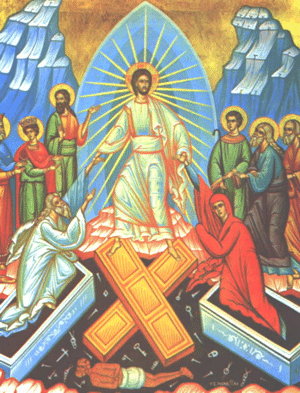
Pascha

Make no mistake: if He rose at all
it was as His body;
if the cells’ dissolution did not reverse, the molecules
reknit, the amino acids rekindle,

the Church will fall.


It was not as the flowers,
each soft Spring recurrent;
it was not as His Spirit in the mouths and fuddled
eyes of the eleven apostles;

it was as His flesh: ours.


The same hinged thumbs and toes,
the same valved heart
that--pierced--died, withered, paused, and then
regathered out of enduring Might

new strength to enclose.


Let us not mock God with metaphor,
analogy, sidestepping, transcendence;
making of the event a parable, a sign painted in the
faded credulity of earlier ages:

let us walk through the door.


The stone is rolled back, not papier-mâché,
not a stone in a story,
but the vast rock of materiality that in the slow
grinding of time will eclipse for each of us

the wide light of day.


And if we will have an angel at the tomb,
make it a real angel,
weighty with Max Planck’s quanta, vivid with hair,
opaque in the dawn light, robed in real linen

spun on a definite loom.


Let us not seek to make it less monstrous,
for our own convenience, our own sense of beauty,
lest, awakened in one unthinkable hour, we are
embarrassed by the miracle,

and crushed by remonstrance.

- John Updike, "Seven Stanzas at Easter"

Tuesday, January 27, 2009

Updike Remembered

Here are a few of my favorite tributes to the man:

Michiko Kakutani had some harsh words to say about Updike while he was alive, but in this piece she takes a more balanced view. In an interview with Sam Tanenhaus of the Times last October, Updike had a few laughs about the chilly reception he received from Kakutani, so it's nice to see her give him the credit he's due, while not glossing over his faults.

As I mentioned before, I am not wild about readings that equate Updike with Rabbit Angstrom, but the Guardian does so gently and with appropriate reservations.

Unsurprisingly, the New Yorker has a nice tribute to their most famous contributor of the last five decades. I'm expecting a large section on him in a forthcoming print edition, but who knows if that's going to happen.

James K.A. Smith responds to Updike's death with characteristic intelligence and sensitivity.

I was surprised how thorough and beautiful this AP writeup is. I especially appreciate the quote on Updike's inability to accept atheism, as I identify with it quite strongly.

This is my favorite of the blog tributes to Updike. I'm highly skeptical of any reading of his work that is not informed by theology, and Ben Myers gets it right.

* * * * * * *

As for me, I'll leave you with my (possibly apocryphal) favorite Updike story.

Updike and his publisher, Knopf, expected Rabbit, Run to be brought up on pornography charges, so Knopf went ahead and hired a lawyer, who called Updike at home in Ipswich, Massachusetts, to set up a meeting with him.

"Well," Updike is said to have remarked, "I can't be there this week. I'm teaching Vacation Bible School."

That about sums it up.

Updike at Rest

John Updike died this morning of lung cancer. He was 76.

I'm as much an expert on Updike as anyone I know, but that being said, it's very difficult to be an expert on Updike. He put out at least one book (and often several) almost every year since 1959. These books stretch across almost every genre--he has poems and short stories and novels and memoirs and even a play. I've read maybe a third of his work, so I'm not sure how qualified I am to talk about him.

He was most famous, of course, for his Rabbit series of novels, which deal with a rather unremarkable man from Brewer, Pennsylvania, and the various women he sleeps with and abuses. Rabbit is often identified with Updike himself, but this comparison has always seemed lazy and unfair to me. Updike is no athlete, for example, while Rabbit played high-school basketball and can't get over it. Rabbit is fiercely unintellectual and lives mostly according to instinct. Updike is one of the great thinkers and talkers of his generation. And so forth.

And it's an important point. My Google alert for "John Updike" brings to my inbox every day a blog or two by an angry feminist who thinks that the author absolutely must approve of his character's behavior. I don't think he does. When he received the Campion Medal, Updike said that he always conceived of his characters as object lessons from Kierkegaard and Barth--Rabbit may attract us with his personal charm, but he should disgust us with his refusal to put aside his own instincts and see the world and God as it is. Updike was, best I can tell, the only major American fiction writer to take religion seriously, and if his critics don't, they won't understand him.

Then there's the sex. Updike's work is famously dirty--its sex scenes are graphic, frequently, and (to be frank) disgusting. He won a lifetime achievement award for Bad Sex last year, and it was mostly deserved. But all that flesh served a purpose. Updike's art was fundamentally incarnational, and in presenting the what and how of sex in graphic terms, he, I think, saw himself as presenting some vision of the grace of God. Also, he was kind of a pervert. Did he go too far? Sure, especially in 1968's Couples, which has not aged well, to put it mildly.

That being said, Updike's best work still hits hard. I begin my Comp II classes with "A&P," a story from 1961's Pigeon Feathers, and this semester, the kids have really responded well to it; nearly half of them have written their first paper on the story. (And Updike died on the day I'm conferencing them about these papers, so that my grief is refreshed and renewed every fifteen minutes.) His talent for fiction declined as time went by, and I don't think he wrote a good novel after 1996's In the Beauty of the Lilies, but his criticism was strong right up until what I think was his last published nonfiction piece, a review of Toni Morrison's latest.

Sometime soon I will discuss a nonfiction piece from Updike's most recent/final collection, Due Considerations, one that feels especially poignant today, one that deals with faith's survival into the modern world. Until then, I'll suggest that his critical and academic reputation will outlast those of the people who hated him, who called him a self-indulgent racist (he wasn't) and sexist (he was, kind of).

The world's loss, perhaps, is heaven's gain, although I'm sure Updike would confess that he had no idea if that's true or not.

Monday, June 9, 2008

Roger's Version and Homosociality


A warning: This post, by its very nature and subject, is quite a bit more explicit than the ones I normally put up here. So if you're easily offended or disgusted by graphic descriptions of sex, I'd suggest you sit this one out.

You can tell I've been with my little gender theorist too long, since I'm starting to view everything through a Judith Butler-colored lens. Queer and gender theory is pretty pervasive in the Academy these days--though perhaps not to the extent it was a decade ago--but in my fairly extensive research in John Updike scholarship, I've not found a critic who applies the theories to his books. So this post is my poor attempt to do so; at some point, I'll maybe expand this into a full paper, but honestly, I don't know the theory well enough to apply it in any professional capacity.

Updike's books (at least the ones I've read) all contain pretty similar elements. They all deal with the intersection of faith, death, and sex, and they all depict that sex in graphic, almost disgusting ways. (When I introduced Updike to my Comp II class last semester, I told them that "Updike's sex scenes tend to be more gross than erotic...just like real sex" and enjoyed the horrified looks.) They all feature some form of adultery, and for the most part have one of two endings: (a) The adultery is discovered but never really dealt with, but it's not really a big deal (Rabbit Run and Roger's Version); or (b) Husbands end up with different wives (Couples and Marry Me). There are exceptions to this general rule of course--for example, In the Beauty of the Lillies is light on sex compared to Updike's other novels, and it's ending is violent rather than sexual--but this is the general trajectory of his work.


As such, his attitude toward adultery is really, really important in terms of understanding his work as a whole. Critics go a bunch of different directions with this--for example, Frederick Crewes infamously argues that Updike's entire post-1968 output is an attempt to justify his own adultery, whereas others argue that adultery is no big deal because he's a Lutheran, and Lutherans care less about individual actions than overall orientation. I'm not terribly interested (at least not in this post) in determining Updike's own sexual ethics; I'm more concerned with his characters' motivations for adultery.

Eve Kosofsky Sedgwick wrote the defining work on male literary homosociality, 1985's Between Men: English Literature and Male Homosocial Desire. (Interestingly, Sedgwick's book came out the same year as Updike's Roger's Version, and the covers of the books are the same sickly shade of pale green. A coincidence, I'm sure, but an interesting one.) Her first chapter, "Gender Asymmetry and Erotic Triangles," is the important one for Updike studies.
First, a definition for those not familiar with queer theory:
"Homosocial" is a word occasionally used in history and the social sciences, where it describes social bonds between persons of the same sex; it is a neologism, obviously formed by analogy with "homosexuality," and just as obviously meant to be distinguished from "homosexual." In fact, it is applied to such activities as "male bonding," which may, as in our society, be characterized by intense homophobia.
So "homosocial" does not refer to homosexuality exactly, but instead a range of activities involving pairs or groups of men. Sedgwick's point, however, is that the line between homosexuality and homosociality is so thin as to not be a line at all; both experiences exist on a continuum, and it is possible for men to be engaging in homosexuality under the auspices of homosociality. (This system is not such a problem for women, who cross from one to the other without much problem.)

In her first chapter, Sedgwick claims that love triangles (in literature and, I suspect, in real life) demonstrate this continuum well, since "the bond between rivals in an erotic triangle [is] even stronger, more heavily determinant of actions and choices, than anything in the bond between either of the lovers and the beloved." We see this sort of phenomenon all through Updike's catalogue. There is the rivalry between Rabbit Angstrom and Ronnie Harrison, for example. The women passed between the two men come and go--Ruth in Rabbit Run, Thelma in Rabbit Is Rich and Rabbit at Rest, and, after Rabbit's death, Janice in "Rabbit Remembered." These relationships are controlled in large part by the rivalry between the two men. Rabbit makes Ruth go down on him after hearing she did so to Ronnie years before; Ronnie's rivalry with Rabbit must have played some part in his decision to marry Janice; and Rabbit shows little interest in anal sex until he learns that Ronnie and Thelma engage in it. Updike's use of anal sex is telling, since sodomy is chiefly associated, at least by straight men, with male homosexuality.

Sodomy shows up in Roger's Version, as well. The novel deals with Roger Lambert, a staunch Barthian professor of heresy at a New England college. Roger doesn't have much faith, despite his claims that he does, but he's still personally offended when a young science student, Dale Kohler, tells him that he wishes to prove God's existence with a computer. The novel is heavily theological, but that's beside the point as far as this post is concerned. What's important is that Roger imagines Dale to be having an affair with his wife, Esther, and that much of the last half of the novel is composed of his fantasies about the affair.

We are never certain whether the affair actually happens or not--Roger is told at the end of the novel that Dale is sleeping with an older woman, but we don't have any real evidence that that older woman is Esther. But Roger is convinced and constructs graphic fantasies about their lovemaking. These hypothesized acts are far more explicit and detailed (far more Updikean, in other words) than Roger's own sex scenes, which primarily take place off-camera. Roger goes into great detail about Dale and Esther's lovemaking, and, tellingly, imagines at one point that the two engage in anal sex. He seems to enjoy the thought:

In truth Dale's desire, with Esther's connivance, to possess her completely, her slender perishable body, has led them lately in their lovemaking to that smallest, tightest orifice as well. Dale remembers the grip of the cold greased sphincter and the sight of the nape of her dear neck tense at the other end of her spine and blushes.

But it is Dale, not Roger, who blushes; nor does he blush when describing the oral sex Esther performs on his rival:
Esther loves being sluttish with this boy; he is so purely grateful and astounded and would never think to use it against her . . . This tall bony youth of shining skin and thrilling phallus has been somehow delivered to her. She gorges herself on his flesh until her jaws ache. In the respite, gasping and wiping her lips, she croons, "So big. Too big for my mouth."
Creepy. Roger imagines the two acts most associated with male homosexuality and applies them to his rival's hypothetical affair with his wife, taking great pleasure in describing them and imagining Dale's penis to be enormous. Surely there's some wish-fulfillment there. His fantasies of the affair even begin with a description of what he imagines Dale's penis to look like:
I pictured a white shaft: tense, pure, with dim blue broad veins and darker thinner purple ones and a pink-mauve head like the head of a mushroom set by the Creator upon a swollen stem nearly as thick as itself, just the merest little lip or rounded eaves, the corona glandis, overhanging the bluish stretched semi-epiderm where pagan foreskin once was, and a drop of translucent nectar in the little wide-awake slit of an eye at its velvety suffused tip.
All of this begs a question: Who is Roger jealous of in this fantasy? It appears to be Esther, more so than Dale, since he thinks about his ostensible rival (maybe something closer to beloved) almost all the time, imagining not only his affair with Esther but his day-to-day life as well. The feelings seem to be mutual; Dale says at one point that he thinks of Roger as he is lying in bed at night.

This homosoci-/sexuality between rivals is not unique in Updike's work--it has showed up in everything I've read by him--but Roger's Version's fantasy setup allows Updike to foreground the desire between Roger and Dale. But what do we do with it? Despite his own frailness--he was not particularly athletic as a child and has suffered for seven decades with psoriasis--he is one of the most masculine writers still alive; a character in In the Beauty of the Lillies even receives his salvation by becoming a big, tough man and killing some people. But the homosocial desire present in these books subverts our very notions of masculinity (perhaps even Updike's notions, as I'm not sure how much of this results from conscious artistic decisions)--it has a similar effect to the dirty jokes nerds tell about football players tackling each other.

Perhaps with a little more probing (pun intended), this could be ammunition in the battle against Updike's sexism--anyone, after all, who subverts notions of heterosexual masculinity this much can't be an out-and-out sexist, can he?

Updike Interview

I know it's been forever, but here's a link to a great interview with John Updike--I'm putting it here in preparation for a forthcoming post on Roger's Version.

Note that he, like me, praises those 1930s Disney shorts. Wonderful stuff.

PS: I'm engaged.

Saturday, May 10, 2008

The Stooge

I avoided reading Tom Wolfe for some time because of his fifth-grade reaction to criticism from John Updike (whom I love), John Irving (whom I like), and Norman Mailer (whom I've never read). So now that I'm finally reading Bonfire of the Vanities, I'm wondering if their criticism was fair.

Updike said that Wolfe's "A Man in Full still amounts to entertainment, not literature, even literature in a modest aspirant form. Like a movie desperate to recoup its bankers' investment, the novel tries too hard to please us." Updike is usually not such a bloodthirsty critic; in my fairly extensive reading of his nonfiction, I've been struck by how magnanimous he is, always trying to find good things about books he doesn't like. So I'm going to assume that either (a) He really, really hates A Man in Full; or (b) He is somehow personally threatened by Tom Wolfe.

Mailer was a little more veiled in his criticism, calling Wolfe ""the most gifted best-seller writer to come along since Margaret Mitchell" and coyly noting that "Extraordinarily good writing forces one to contemplate the uncomfortable possibility that Tom Wolfe might yet be seen as our best writer. How grateful one can feel then for his failures and his final inability to be great--his absence of truly large compass."

I'm going to avoid dealing with Updike's criticism of Wolfe, mostly because doing so would involve defining "literature," which Updike is probably happy to do but which I am not. But I think Mailer is on to something here. Bonfire is enormous, fiction (or literature, whatever) on a grand scale--other critics have noted a similarity to Dickens (as they have with Irving), and that's fair enough. But at the beginning, the book gave me the impression that it will be a Percyan novel ideas, wrapping Wolfe's wordy prose around guilt and sin and bigotry and a million other issues.

But Wolfe can't control this for long; like Mailer, I think he lacks a "truly large compass." Less than halfway through, Bonfire of the Vanities turns into a potboiler, plot-driven and hurried. That doesn't make it bad--it just makes it less permanently interesting. It's a page-turner, but I don't think I'm going to remember much about it next year. On the other hand, other than its length, the novel is custom-made for a film adaptation, whereas something like Lancelot is less immediately engrossing but has more permanent value, at least for me.

The same is true of Irving, although I'll argue that Irving's prose is better-written. Lisa Simpson introduces Wolfe to Moe the Bartender by saying "He uses more exclamation points than any other living author." I'll vouch for that and add to it, elipses. Nearly every paragraph features ten-plus exclamation points and at least five aggravating dot-dot-dots. In this, he reminds me of that most overrated of 19th-century authors, Edgar Allan Poe (who himself plays a minor role in Bonfire of the Vanities). I come close to hating Poe, and I hate him because of the stagy melodrama of his prose. Like Wolfe, he's plot-driven, despite his fan base's concerted attempts to prove otherwise, and like Wolfe, he's a fan of exclamation points, italics, and dashes. Too many of Poe's short stories end with a frenzied interjection: "I had walled the monster up within the tomb!"; "[he]--was the man that was used up"; "These are the full, and the black, and the wild eyes--of my lost love--of the lady--of the LADY LIGEIA!" It's the stuff of B-grade horror films, and it's no wonder Vincent Price adapted so many Poe stories.

Wolfe is better than Poe, though. While he cannot sustain a philosophical theme through the course of his enormous novel, he at least has grand ambitions (I am still not convinced E.A.P. did), and his prose is never less than enjoyable, while any trip through Poe is like slogging through the streams of vomit and urine that so populate his stories. Literature? Who cares? Cohesive? Probably not. But Wolfe's worth reading--if not for the questions he halfheartedly raises . . . then at least for the way he ignores them!

Sunday, April 13, 2008

Updike and Emerson, Pt. 2


In my last post, I argued that (a) both Updike and Emerson tend to be victims of the P.C. Age in academia; and that (b) the former has a certain understanding of and affection for the latter. In this post, I will point out similarities to Emerson's thought in Updike's most famous and most well-read book, 1961's Rabbit, Run.

I've read Rabbit, Run more times than any other book, beginning my senior year of college, although I've never been assigned the novel in a class. I didn't assign it as my Freshman Comp II class's novel, either--my students did not by and large respond positively to "A&P" (a dagger through my heart!), and I didn't want to have to defend the graphic sex in the novel, even if the sex in Rabbit, Run pales in comparison to nearly every other Updike novel. I've written two class papers on the novel--one comparing Harry "Rabbit" Angstrom to Mr. Wheelock in Dorothy Parker's "Such a Pretty Little Picture" and one tracing the history of the criticism of the novel, from the early reviews that treated Rabbit as an existential hero to more recent criticism that treats him or his author as a terrible human being.

That's one of the major debates swimming around Rabbit, Run--are we supposed to admire or condemn Rabbit Angstrom? He abandons his wife and child, not so much to find a better life as because he's just bored. His decisions wreak havoc on his family; they destroy almost everything stable in the novel, but Rabbit doesn't seem to mind. And then when he decides to return to his wife, he wreaks his mistress' life, too. Is this just the price to pay for freedom? Or is Updike, the semi-orthodox Christian, giving us an object lesson of something to avoid?

I take the viewpoint that Updike condemns his most famous protagonist, however gently he does it. There's really nothing special about Harry; he works as a salesman in all four of the novels, and while he seems to have some talent for it, that speaks against rather than for his specialness. In Rabbit, Run, he is an emblem of the alienation of the lower-class male; with nothing to distinguish his pathetic life from the pathetic lives of those around him, he must convince himself he is special by clinging to basically four things: sex, food, gardening, and basketball. (I won't go into detail on most of these here.)

His reasoning for the flight he takes away from his wife sounds distinctly Emersonian. Emerson famously takes Socrates' command to "Know Thyself" and expands it to
Trust thyself: every heart vibrates to that iron string. Accept the place the divine providence has found for you, the society of your contemporaries, the connection of events. Great men have always done so, and confided themselves childlike to the genius of their age, betraying their perception that the absolutely trustworthy was seated at their heart, working through their hands, predominating in all their being. ("Self Reliance." Essays and Lectures. Library of America, 1983.) 260.
Updike suggests this passage in Rabbit, Run; Harry receives his flight recommendation from The Mickey Mouse Club, where an adult Mousketeer named Jimmie conflates "Know Thyself" with "Be Thyself":
Know Thyself, a wise old Greek once said. Know Thyself. Now what does this mean, boys and girls? It means, be what you are. Don't try to be Sally or Johnny or Fred next door; be yourself. God doesn't want a tree to be a waterfall, or a flower to be a stone. God gives to each one of us a special talent . . . And He gives to each of us the special talents to become these things, provided we work to develop them. We must work, boys and girls. So: Know Thyself. Learn to understand your talents, and then work to develop them. (Fawcett, 1996. 10).
Rabbit's spiritual advice, then, comes from Emerson by way of Walt Disney.

But Rabbit--never a great thinker--ignores the rest of Emerson's catalogue in formulating his non-plan for escape. In this way, he is a typical reader of Emerson, disgarding a 40-year career and focusing entirely on "Self-Reliance." Emerson's philosophy is not, after all, quite so simple as that essay makes it out to be. Whereas he claims there that he will follow his own impulses and that "if I am the Devil's child, I will live then from the Devil" (262), he elsewhere admonishes his readers to do the right thing, even if the right thing is not their natural impulse: "Let a man keep the law,--any law,--and his way will be strown with satisfactions" ("Prudence" 360). It seems that you can and should trust yourself only once you've committed yourself to the spiritual laws of the universe and to Emerson's famous Oversoul, that part of the Divine that fills all of us. Freedom, for Emerson as for Kierkegaard, is twinned with responsibility, because
A man cannot speak but he judges himself. With his will, or against his will, he draws his portrait to the eye of his companions by every word. Every opinion reacts on him who utters it. ("Compensation" 294)
I suggest that for Emerson, trusting oneself is ultimately the same thing as trusting society, providing that society consists of self-actualized individuals who are aware of their connection to one another through the Oversoul.

And so Harry Angstrom is not an emblem of Emersonian self-realization or even of self-trust. He trusts himself, but for all the wrong reasons; he trusts himself in the face of all evidence to the contrary. As another character tells him, "you worship nothing except your own worst instincts" (115). Even after he wrecks the lives of nearly everyone around him, he can't see that his compass is out of line, and the novel ends with him running off into the sunset yet again. This running strikes me as distinctly non-Emersonian in and of itself; it is the opposite of taking a bold stand on one's beliefs; it is pure cowardice.

Now, as I think that the New Yorker piece suggests that Updike was aware of the range of Emerson's material and was not interesting in pinning him down to the simplistic evaluation typical of lay readers, it cannot be a mistake that Harry's philosophy sounds like but is not Emerson's. When I first read the novel, I assumed it was a critique of Emerson, and maybe it is; maybe Updike didn't read the rest of Emerson's catalogue until he wrote that piece in 2003; or maybe it, like Pierre, it's a critique of a certain aspect of Emerson's philosophy. But since I love Updike and I'm beginning to love Emerson, I choose to believe that among other things, Rabbit, Run is a critique of misreadings of Emerson, an object lesson drawn from "Compensation" and "Prudence" rather than from "Self-Reliance."

Friday, April 11, 2008

Updike and Emerson, Pt. 1

I love John Updike. My 95-page chapter on the first two Rabbit Angstrom books was my favorite part of my master's thesis, even though it got cut because it was an "indefensible argument." (I can tell that story another time, if anyone is interested.) And I love his criticism; Updike seems like he reads for 18-20 hours per day, and his comments and evaluations are usually sharp and interesting.

So you can imagine my horror today when a visiting philosopher, Dr. Russell Goodman (who's a very nice, very approachable, and brilliant man), took a potshot at him during a lecture on Ralph Waldo Emerson and Pragmatism. He talked about common misconceptions and oversimplifications of Emerson's message; he's often treated as though his sole message were "follow your bliss d00d," a viewpoint which ignores almost every essay other than "Self-Reliance."

"The New Yorker, for example," he said in a voice dripping with irony, "had John Updike"--he pronounced that name with the sneer that I'm used to hearing from academics--"write a condescending piece on Emerson. And then, 25 years later, they couldn't find anyone new, so they had Updike write another one." Goodman suggested that Updike subscribes to the popular view on Emerson's thought and condemns him for his own misreading. I was upset at first, but I rethought my opinion; I'd read the second piece, from 2003, but at that point I hadn't read all that much Emerson and my own opinion followed those oversimplifications pretty closely. Maybe Updike dropped the ball on this one. I mean, the man's not perfect.

I own two books of Updike's criticism--Picked-Up Pieces and Hugging the Shore--but that's not even half of his critical output, and I couldn't find his original (1970s?) essay on Emerson in them. But he makes offhand references to the Sage of Concord from time to time, always in either neutral or positive terms. Here's an example, from an essay called "Whitman's Egotheism":
Like many of his radiant literary generation, he borrowed courage from Emerson; but Whitman's brave advice bears no accent of the lectern, and small flavor of the stoic.
Updike may privilege Whitman here, as he privileges Melville elsewhere, but this is hardly a condemnation of Emerson; he gives the latter credit for the former's existence. Elsewhere, he claims that Emerson began a new tradition in American prose style, "cranky, granular, impulsive, confessional." This description is a positive for Updike--he uses it to contrast John Cheever's "taut and mordant" older style with his newer, more satisfactory one.

In an essay on Knut Hamson, Updike actually takes the author to task for criticizing Emerson, and it is by means of the conventional misreading of Emerson that Hamson is able to criticize him: "Emerson's major failings are 'his undeveloped psychological sense and thereafter his overdeveloped moral sense.' Reverse the proportions, and you have Hamsun." Updike does not in this essay directly combat the myth of Emerson--after all, the enemy of my enemy is not my friend--but he hints at it.

It's not until "Big Dead White Male: Emerson Turns 200" in 2003 that Updike directly rejects the Emersonian myth. I am not sure how Goodman found the article condescending; Updike has clearly read nearly everything that Emerson produced, and his tribute to him reads a bit like a hagiography. He praises him for his antinomianism (usually a positive quality in Updike's brand of Christianity), and says that only Poe equalled him"as a homegrown critical and creative mind." (I have my own, anti-Updike opinions of Poe, but nevermind for now.)

I wonder if Goodman does not mistake Updike's attack on Lawrence Buell for an attack on Emerson. He is indeed harsh to Buell--a major scholar of the American Renaissance and, though I cannot find the evidence, a man who I am certain has written some major essay or another on Updike--whom he accuses of ivory-tower intellectualism and defensiveness. I think these are critiques that Emerson would get behind, at least in principle; after all, John Dewey argues that he is the "philosopher of democracy," always privileging the pragmatic over the abstract, and Emerson himself never bowed to or defended the past.

Besides that, I think that Updike is in actuality defending Emerson against Buell and other ivory-tower types:
A hundred years after Emerson's centennial was declared a school holiday in Concord and marked by an oration by William James and a public prayer that the spirit of Emerson inspire all present, he is put forward gingerly, apologetically, as a devalued stock on which we might still want to take a flyer . . . The endorsement seems excessively hedged, linking the sage's value to a presumed madness in society. Emerson was too much a realist, I think, to dismiss the workings of a society as mad, even a society like his own, passionately riven antebellum America. He pitched his palace of the Ideal on the particularities and rationale of what existed.

Updike's problem is with the political correctness that attempts to "prove" that Emerson was a racist or a classist and that discards his work because of it. These concerns are beside the point; and Emerson still has a lot to say, particularly in the essays which people don't usually read. Updike views Emerson as a consummate humanist, speaking directly to the human condition and offering concrete advice for it.

If this whole debate sounds familiar, it's because it's the same one that rages around Updike himself. Is he a racist? Is he a sexist? Maybe--that's not really my call to make. But his novels manage to speak to me, and they speak to many others as well, even if the Academy treats him as damaged goods. I've been at three different schools now, and I'm still the only academic I know who deals with him. And I don't get why that's the case.

Part 2 of this post will involve an Emersonian reading of Rabbit, Run, but give me a few days.